Reading Time | 6 Minutes
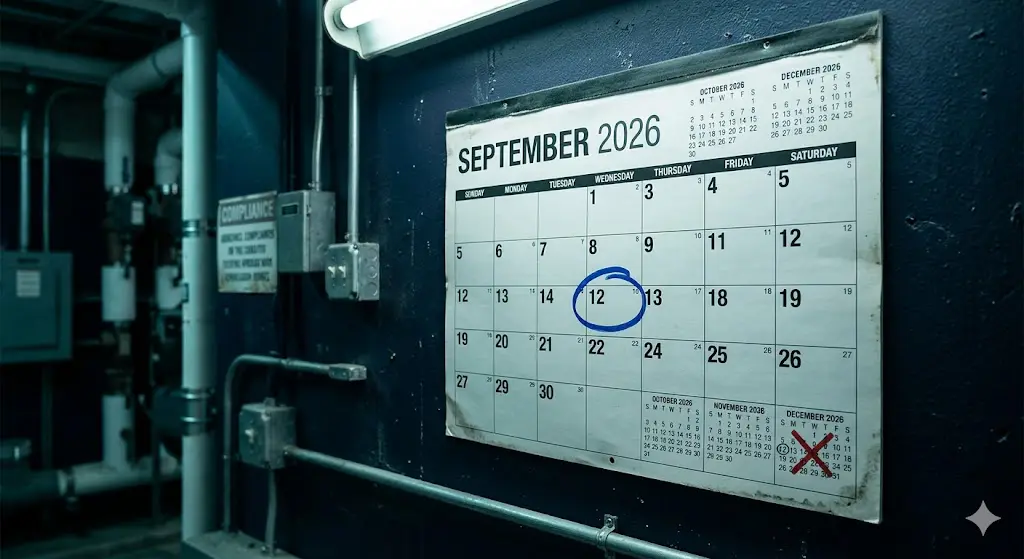
Most New Jersey facility managers think they have until September 12, 2026 to comply with NJ S2188 — the state’s Legionella water safety law. That date is real. But NJ S2188 has two compliance deadlines, not one, and the second deadline — December 12, 2026 — is the one that determines whether your compliance actually holds up during an inspection. Facilities that start their Water Management Plan in August are not “just in time.” They are already behind on the second deadline before they’ve met the first.
Here is what the law actually requires — and why the timeline most facilities are operating on puts them in violation before the first deadline even arrives.
NJ S2188 establishes two separate compliance deadlines. Covered facilities must have a completed Water Management Plan aligned with ASHRAE Standard 188 by September 12, 2026. That plan must then be actively implemented — with monitoring logs running, staff trained, and corrective action protocols in place — by December 12, 2026. The 90 days between these deadlines is required program time, not buffer.
NJ S2188 establishes two separate compliance milestones. They are not interchangeable. Most public communication about the law collapses them into one date — September 12, 2026 — which creates a dangerous illusion of time that does not exist.
Deadline 1 — September 12, 2026: Water Management Plan Developed
Your Water Management Plan must be fully written, documented, and aligned with ASHRAE Standard 188. It cannot be “in progress.” It must exist, reviewed and signed off, before this date.
Deadline 2 — December 12, 2026: Water Management Plan Implemented
Your program must be actively running. Monitoring logs started. Staff trained. Corrective action protocols in place and documented. At least one full monitoring cycle completed. Not just on paper.
The Gap — 90 Days: Required Implementation Window
This is not buffer time. This is not padding. It is the minimum operational ramp-up time for a compliant program. If your plan is not written and finalized by September 12, your implementation window shrinks or disappears entirely. Facilities that start their Water Management Plan in September are already behind on Deadline 2 before Deadline 1 is met.
Download our free compliance checklist and find out where you stand before the September 2026 deadline.
Implementing an NJ S2188-compliant Water Management Plan requires establishing baseline Legionella testing, setting verified control limits across all water systems, training staff on monitoring protocols, completing at least one full monitoring cycle, and posting required public notices — none of which can be backdated or rushed through in the days before an inspection.
A Water Management Plan under ASHRAE 188 is not a document you fill out and file. Implementation means the plan is operationally active across your facility’s water systems. That requires time, sequencing, and in many cases, physical verification of your building. Here is what implementation actually involves:
Inspectors do not ask to see your plan. They ask for your logs, your test results, and your corrective action records. If your monitoring program has been running for two weeks when an inspector walks in, that is a red flag regardless of what the plan document says. The facilities that pass inspections are the ones that can show an auditable trail of active management over time — not a document they handed to a consultant last week.
Water Management Plans take up to 8 weeks to develop — schedule your ASHRAE 188 assessment today.
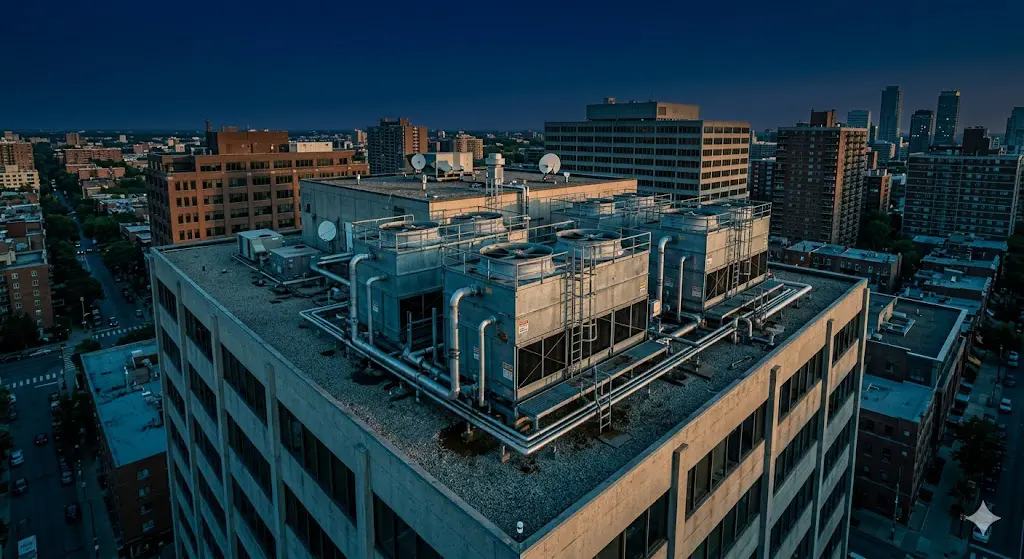
NJ S2188 covers any facility with a cooling tower, hospitals and inpatient care facilities, nursing homes and assisted living, senior and age-restricted housing, hotels and motels, high-rise residential buildings (6+ stories), and any facility with aerosol-generating water features including whirlpool spas, decorative fountains, and misters. If your building has a cooling tower, you are almost certainly covered.
A common assumption is that S2188 targets hospitals and nursing homes. That is where most public communications about the law lead. The actual scope is wider. The detail that catches the most facilities off guard is this: any building with a cooling tower is almost certainly in scope.
A cooling tower is not a healthcare-specific system. It is present in office buildings, apartment complexes, hotels, warehouses, and any commercial building with central air conditioning. Facility managers in non-healthcare settings frequently assume S2188 does not apply to them. For many, that assumption is incorrect.
Covered facility types include:
If you are uncertain whether your facility qualifies, that uncertainty is worth resolving now, not in August.
NJ S2188 penalties range from $2,000 for a first offense to $5,000 for subsequent violations, with fines up to $10,000 per violation when non-compliance results in serious injury or death. These are per-violation figures — a facility with multiple deficiencies can face compounding fines from a single inspection.
First violation: up to $2,000. Subsequent violations: up to $5,000. Violation resulting in serious injury or death: up to $10,000. A building with multiple deficiencies — missing logs, untrained staff, no public notice — can face multiple violations in a single inspection visit.
Developing an ASHRAE 188-compliant Water Management Plan for most NJ facilities takes 4 to 8 weeks when working with an experienced provider. Complex facilities with multiple building types, multiple cooling towers, or both domestic and process water systems may require 8 to 12 weeks. These timelines assume prompt access to facility water system documentation and site survey scheduling.
A compliant WMP requires a full water system survey, hazard analysis, identification of all control points and limits, documented monitoring protocols, and corrective action procedures. For most facilities, developing this plan takes 4 to 8 weeks. Longer for complex facilities or those with multiple water system types.
Work backward from December 12, 2026. Allow 90 days for active implementation — that brings you to mid-September, which means your plan must be complete by September 12 at the absolute latest. Now subtract 6 to 8 weeks for plan development. Now account for provider scheduling. The window is already narrower than the September 12 date suggests.
If you start in July, you are cutting it close. If you start in August, you are almost certainly going to have a plan that is either incomplete by September 12 or rushed in ways that show up during an inspection. If you have not started yet, the right window is now.
This is not manufactured urgency. The math is the math.
Get a compliant Water Management Plan in place before NJ S2188 inspectors show up.
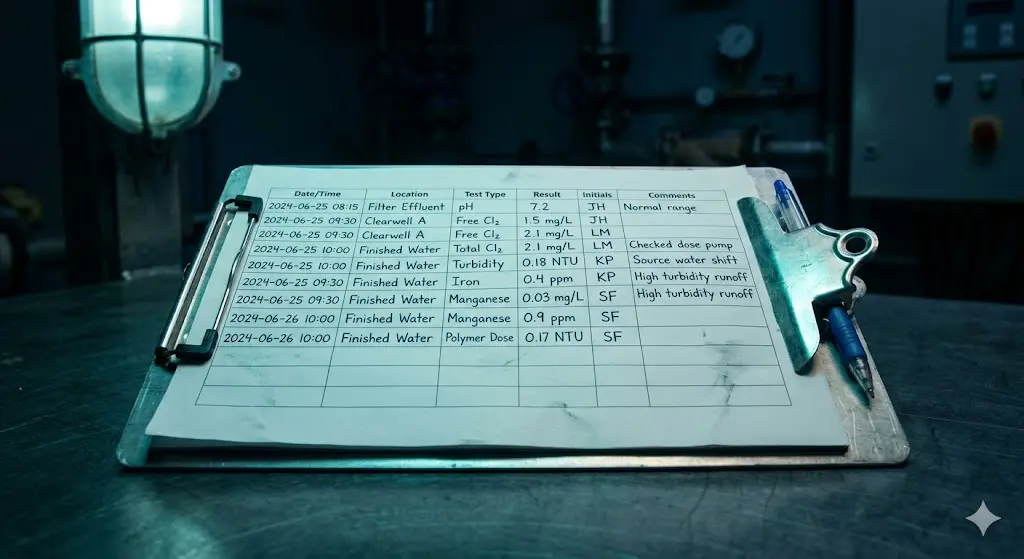
NJ S2188 inspectors look for active monitoring logs with dated test results at all control points, documented staff training records, corrective action documentation for any exceedances, evidence of required public notices, and a Water Management Plan covering all water systems on the premises. A plan that exists but is not operationally active — with consistent, dated monitoring records — is not a compliant program.
The distinction between a plan that exists and a program that is running is the core of what inspectors evaluate. A fully written plan with no monitoring logs is not a compliant program. A facility with two weeks of monitoring logs and a plan signed last month is not a compliant program. The auditable trail — consistent, dated, attributable to specific systems and specific staff — is what passes an inspection.
Three actions that move the needle immediately, in priority order:
If you have a cooling tower, an inpatient care component, senior housing, or aerosol-generating water features, the answer is almost certainly yes. Do not assume otherwise without verifying against the statutory facility categories. The cooling tower provision alone covers most NJ commercial buildings.
Before a Water Management Plan can be written, someone needs to understand your actual water system configuration, control points, current disinfectant levels, and risk profile. This cannot be documented from a spreadsheet or a previous vendor’s report.
Providers with capacity to take on new NJ S2188 clients will fill up. Facilities that wait until June or July will find the options narrower and the timelines tighter than they expect.
September 12 is a real deadline. December 12 is the one that determines whether your compliance actually holds up. The gap between them is not buffer time. It is required program time, and you need to be in it — not approaching it. This is not manufactured urgency. The math is the math.
Book a 30-minute conversation directly. We'll discuss your building water safety and Legionella risk situation and whether working together makes sense.
Book a 30-minute call →Take a look at our Legionella treatment services first. See where you stand across your water safety plan, risk controls, and regulatory compliance posture — then decide if a conversation makes sense.
Find out what a buyer would see →Browse everything we do in building water safety and Legionella management — chemicals, programs, and compliance support — at your own pace, no conversation required.
Explore our water safety solutions →We work with advisors who encounter water safety and Legionella risk gaps in their client businesses. If you're looking for a referral partner for pre-sale readiness work, let's talk.
Learn about our partner program →