Reading Time | 10 Minutes
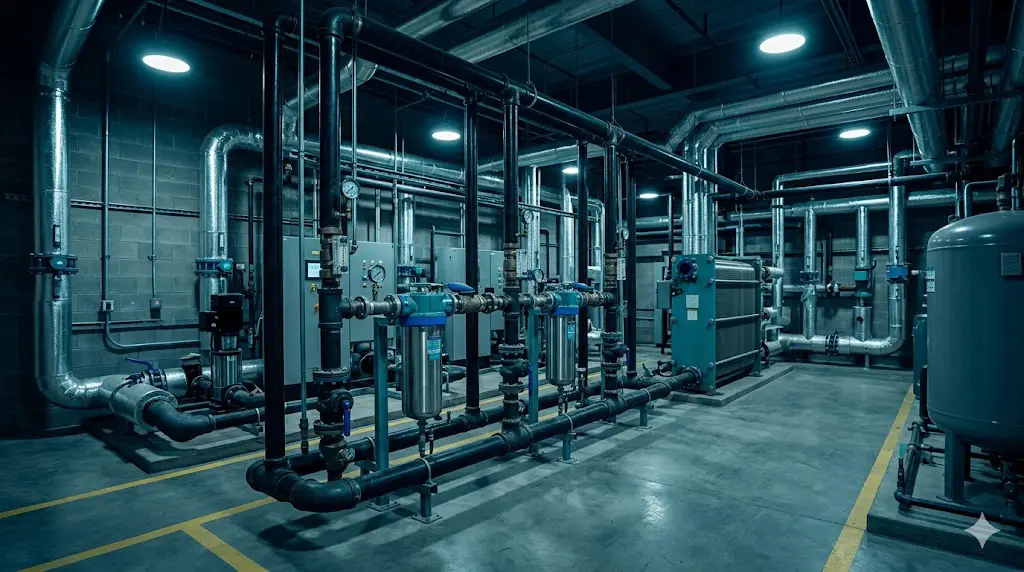
Most facility teams treat their closed loop water chemistry. They add inhibitor, test regularly, and keep the pH in range. That’s the right move — but it only solves half the problem.
The other half is physical: iron oxide particles, rust flakes, and fine black magnetite already suspended in the water. They circulate through pumps, settle in coil headers, and pack into heat exchanger tubes. No amount of corrosion inhibitor removes particles that are already there.
That’s what magnetic filtration is for.
⚡ Quick Answer: What Is Magnetic Filtration for Closed Loops?
Magnetic filtration uses a high-strength permanent magnet installed in a side-stream bypass to continuously pull ferrous particles — especially fine magnetite — out of circulating loop water. Unlike mesh strainers, it captures particles down to a few microns regardless of size. It does not replace a chemistry program; it removes the physical byproducts of corrosion that chemistry cannot touch.
Closed loops are sealed systems, which leads most people to assume the water stays relatively clean. It doesn’t. Steel piping corrodes continuously — even in a well-treated loop, the metal surface reacts with water at a low level, producing iron oxide particles primarily in the form of magnetite: a fine black powder with one critical property.
It’s magnetic. And most standard filtration equipment ignores it entirely.
In a loop that overwintered with depleted inhibitor, corrosion was accelerating for months. By spring startup, the suspended particulate load can be significant — and it doesn’t show up in a visual inspection of the water.
Magnetite is abrasive. When it circulates through pump impellers and valve seats, it acts like fine sandpaper — scoring metal surfaces, opening new corrosion sites, and shortening equipment life. A loop can show good inhibitor concentration and correct pH on a water test and still be actively degrading mechanically.
Here’s how to think about it:
The chemistry program prevents new corrosion.
The filtration removes the physical evidence of corrosion that already happened.
A complete closed loop program needs both — not one or the other.
A free water analysis gives you a clear picture of what’s actually in your closed loop right now — iron levels, inhibitor concentration, pH, and biologics. One sample pull, results in about a week.
Every closed loop has a strainer. They catch large debris: scale flakes, gasket material, pieces of pipe scale. They do useful work. But a standard Y-strainer or basket strainer works by size alone — water passes through a mesh, and everything smaller than the mesh opening keeps circulating.
Magnetite particles are often just a few microns across. They go right through a standard strainer without slowing down.
| Filtration Type | What It Catches | Catches Magnetite? | Main Limitation |
|---|---|---|---|
| Standard Y-strainer | Large debris, scale flakes, gasket material | No | Mesh size — only catches large particles |
| Side-stream bag/cartridge filter | Mid-size particles, some fine suspended solids | Partial | Filter change-outs required; fine magnetite passes |
| Magnetic filtration (MagStrainer) | Ferrous particles at very fine sizes, including magnetite | Yes | Only captures ferrous/magnetic particles |
Magnetic filtration uses a strong permanent magnet to pull ferrous particles out of the water as it flows past. The particles adhere to the magnet rather than continuing to circulate. Because capture depends on magnetic attraction — not particle size — even the finest magnetite gets pulled out.
The Water Confidence Assessment walks through the four variables that determine whether your loop is actually protected — chemistry, filtration, monitoring, and service frequency. Five minutes. Free.
The MagStrainer installs in a side-stream configuration — a small percentage of the loop flow is diverted through the unit continuously while the rest of the system runs normally. No shutdown required to install. No restriction to main loop flow.
| Step | What Happens | Why It Matters |
|---|---|---|
| 1 | Side-stream draw — A controlled bypass pulls a portion of loop water through the MagStrainer housing. | Keeps the main loop at full pressure and flow during filtration. |
| 2 | Magnetic capture — High-strength permanent magnet pulls magnetite and iron-based particles from the water column and holds them against the magnet core. | Captures particles a mesh strainer cannot — down to a few microns. |
| 3 | Treated water returns — Cleaned water re-enters the main loop. Particulate levels drop across the full system as more total volume cycles through. | Cumulative cleanup: the longer it runs, the cleaner the loop. |
| 4 | Magnet cleaned at service — During regular visits, the magnet is removed, wiped clean, and reinstalled. What comes off tells the story of what was in the loop. | Visual corrosion diagnostic: sludge quantity is a real-time indicator of loop health. |
ChemREADY commonly pairs the MagStrainer with a Neptune Filter Feeder in the same side-stream line, handling both filtration and chemical dosing from a single connection. This keeps the installation compact and makes service visits significantly more efficient.
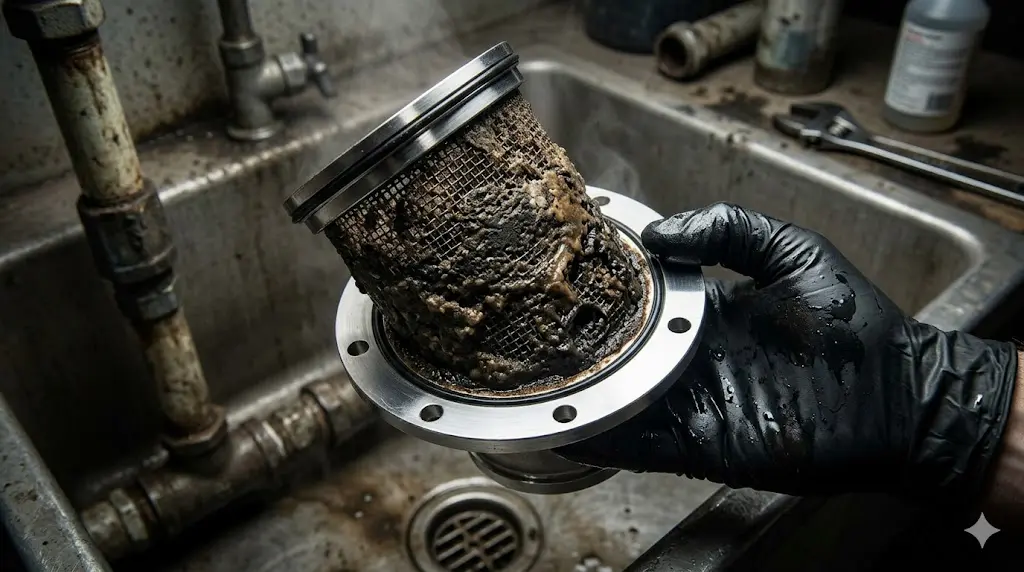
During the first few cleanings after installation, it’s common to pull substantial black sludge off the magnet core. That material was circulating through your pumps and coils before it was captured.
After a few service cycles, buildup typically decreases as the loop cleans up. If it doesn’t drop off — if you’re still pulling heavy sludge after several cleanings — that tells us active corrosion is still happening and the chemistry program needs adjustment. The magnet becomes a diagnostic, not just a filter.
Not every loop needs a MagStrainer on day one. These are the situations where it moves from optional to important:
A full flush removes bulk contamination, but fine magnetite embedded in pipe walls and low-flow zones continues shedding into the water for weeks as the system stabilizes. Magnetic filtration catches that ongoing shed-out before it re-deposits in equipment. Learn more about the full sequence in our water management planning guide.
If water tests show iron rising between service visits — even with a working inhibitor program — circulating particulate is often the cause. Adding filtration frequently resolves this without any chemistry changes.
A strainer that needs cleaning every few weeks is telling you there’s a significant amount of loose material in the loop. That same material is circulating between cleanings. A side-stream MagStrainer reduces main strainer frequency and catches what the strainer misses.
A loop with past corrosion problems has deposits throughout the piping that will continue releasing particles over time. Ongoing magnetic filtration is a practical way to manage background contamination without a full system replacement. Pair with digital remote monitoring for full visibility between service visits.
We can pull a water sample, assess whether magnetic filtration makes sense for your system, and walk you through what a complete closed loop program looks like. Straight answers — no pressure.
Magnetic filtration removes ferrous particles. It does not prevent new corrosion, control pH, inhibit scale, or kill bacteria. Those are chemistry jobs handled by biocides, corrosion and scale inhibitors, and a properly maintained treatment program.
A complete closed loop program uses both tools in sequence:
That sequence produces a loop that actually stays clean between service visits — instead of slowly degrading between them. For a complete overview, see our guide to closed loop water treatment services and how a full water management plan ties it all together.
Book a 30-minute conversation directly. We'll discuss your water treatment situation and whether working together makes sense.
Book a 30-minute call →Take a look at our water treatment services first. See where you stand across chemical programs, system performance, and municipal compliance — then decide if a conversation makes sense.
Find out what a buyer would see →Browse everything we do in water treatment — chemicals, equipment, and services — at your own pace, no conversation required.
Explore our water treatment solutions →We work with advisors who encounter infrastructure gaps in municipal water and drinking water client businesses. If you're looking for a referral partner for pre-sale readiness work, let's talk.
Learn about our partner program →