Reading Time | 5 Minutes
Here’s a conversation that happens more often than it should.
An operator gets hit with a surcharge from their POTW — unexpectedly high solids, pH out of range, something in the effluent that wasn’t supposed to be there. They call their chemical vendor. The vendor tweaks the dosage. Maybe it helps. Maybe it doesn’t. Either way, nobody looked at the actual wastewater and said: here’s what’s in it, here’s what’s driving the problem, here’s what it takes to fix it.
That’s not a chemistry problem. That’s a data problem. And it’s costing facilities real money — in surcharges, in chemical waste, in treatment programs optimized for somebody else’s stream.
Industrial wastewater analysis is the laboratory examination of a facility’s effluent stream to measure what it actually contains — not what it should contain based on industry type. A full characterization identifies organics load, suspended solids, metals, pH drivers, oil and grease, and other contaminants specific to that facility’s process, and tests treatment options against the actual sample before anything is applied to the live system.
Most industrial facilities run wastewater treatment programs built on general chemistry assumptions for their industry type — not on data from their specific stream. That’s not a knock on vendors. It’s how most programs get built: someone reviews your process, makes reasonable assumptions, and recommends a chemical program that should work.
Sometimes it does. Sometimes you’re paying for treatment that overshoots the problem, misses it entirely, or treats a symptom while the root issue compounds. The only way to tell the difference is to analyze the water.
Industrial facilities pay POTW surcharges when their effluent exceeds the discharge limits set by their local publicly owned treatment works — typically for high BOD, elevated TSS, pH excursions, or metals concentrations that require extra processing at the municipal plant. The surcharge is calculated as the cost of treating the excess, billed back to the discharger.
What’s frustrating is that surcharges are often preventable. They show up when a facility’s treatment program is miscalibrated for the actual stream — using the wrong chemistry, wrong dosing, or wrong sequence for what the effluent actually contains. A lab characterization shows you exactly where the gap is.
A full wastewater characterization measures the specific chemistry of your stream — not estimated by industry type, actually measured. Here are the five core parameter groups every industrial analysis should include:
| Parameter Group | Typical Units / Method | Why It Matters for Treatment Design |
|---|---|---|
| Biochemical Oxygen Demand (BOD) | mg/L (5-day test) | Indicates organic load — the primary driver of surcharges at food and beverage facilities. Determines biological vs. chemical treatment pathway. |
| Total Suspended Solids (TSS) | mg/L (gravimetric) | Drives coagulation/flocculation chemistry selection and polymer dosing. High TSS at discharge is direct surcharge exposure. |
| pH Profile | Standard units (0–14) | Controls treatment chemistry effectiveness. Coagulants and flocculants have narrow pH operating windows. pH excursions cause treatment failure. |
| Metals Content | mg/L per element (ICP-MS) | Critical for oil & gas and refining streams. Certain metals trigger categorical pretreatment standards regardless of concentration. |
| Oil & Grease (O&G) | mg/L (hexane extraction) | The primary treatment challenge in produced water, frac flowback, and meat/poultry processing. Dictates DAF sizing and chemistry approach. |
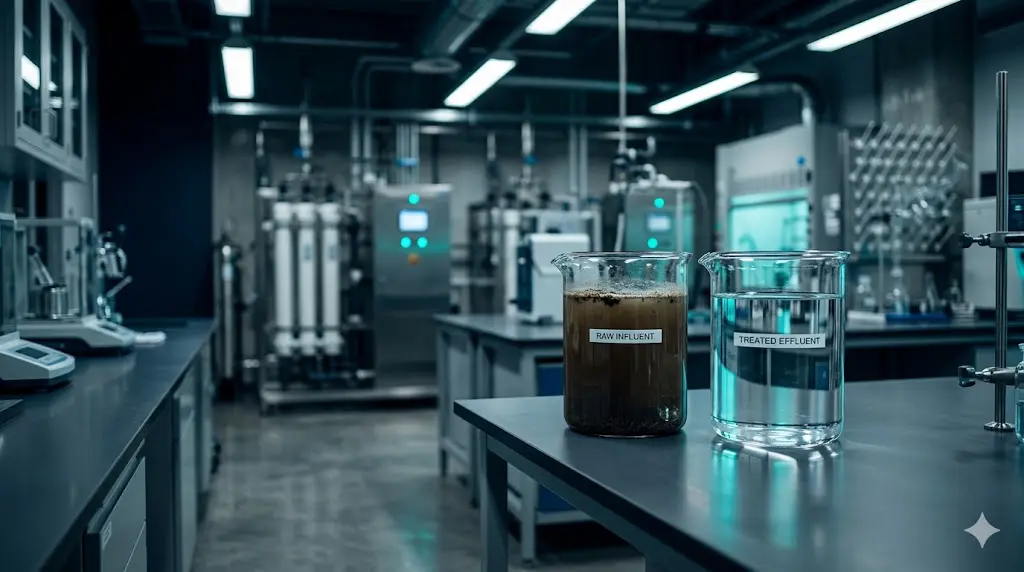
Beyond the chemistry profile, a full characterization includes treatment jar testing — running candidate chemistries against your actual sample in the lab to find what works before committing to a field program. You see before-and-after photos of your sample, not stock images. You get a specific treatment recommendation with dosing rates, not a generic program.
The report also includes transparent pricing on what ongoing treatment would cost, with the math visible before you agree to anything. It’s a data asset, not a brochure.

Send us a sample — we'll run the analysis and translate it into plain-language recommendations for your treatment program.
Industrial wastewater analysis is the laboratory examination of a facility’s effluent stream to measure what it actually contains — not what it should contain based on industry type. A full characterization identifies organics load, suspended solids, metals, pH drivers, oil and grease, and other contaminants specific to that facility’s process, and tests treatment options against the actual sample before anything is applied to the live system.
Most industrial facilities run wastewater treatment programs built on general chemistry assumptions for their industry type — not on data from their specific stream. That’s not a knock on vendors. It’s how most programs get built: someone reviews your process, makes reasonable assumptions, and recommends a chemical program that should work.
Sometimes it does. Sometimes you’re paying for treatment that overshoots the problem, misses it entirely, or treats a symptom while the root issue compounds. The only way to tell the difference is to analyze the water.
Industrial facilities pay POTW surcharges when their effluent exceeds the discharge limits set by their local publicly owned treatment works — typically for high BOD, elevated TSS, pH excursions, or metals concentrations that require extra processing at the municipal plant. The surcharge is calculated as the cost of treating the excess, billed back to the discharger.
What’s frustrating is that surcharges are often preventable. They show up when a facility’s treatment program is miscalibrated for the actual stream — using the wrong chemistry, wrong dosing, or wrong sequence for what the effluent actually contains. A lab characterization shows you exactly where the gap is.
A full wastewater characterization measures the specific chemistry of your stream — not estimated by industry type, actually measured. Here are the five core parameter groups every industrial analysis should include:
| Parameter Group | Typical Units / Method | Why It Matters for Treatment Design |
|---|---|---|
| Biochemical Oxygen Demand (BOD) | mg/L (5-day test) | Indicates organic load — the primary driver of surcharges at food and beverage facilities. Determines biological vs. chemical treatment pathway. |
| Total Suspended Solids (TSS) | mg/L (gravimetric) | Drives coagulation/flocculation chemistry selection and polymer dosing. High TSS at discharge is direct surcharge exposure. |
| pH Profile | Standard units (0–14) | Controls treatment chemistry effectiveness. Coagulants and flocculants have narrow pH operating windows. pH excursions cause treatment failure. |
| Metals Content | mg/L per element (ICP-MS) | Critical for oil & gas and refining streams. Certain metals trigger categorical pretreatment standards regardless of concentration. |
| Oil & Grease (O&G) | mg/L (hexane extraction) | The primary treatment challenge in produced water, frac flowback, and meat/poultry processing. Dictates DAF sizing and chemistry approach. |
Beyond the chemistry profile, a full characterization includes treatment jar testing — running candidate chemistries against your actual sample in the lab to find what works before committing to a field program. You see before-and-after photos of your sample, not stock images. You get a specific treatment recommendation with dosing rates, not a generic program.
The report also includes transparent pricing on what ongoing treatment would cost, with the math visible before you agree to anything. It’s a data asset, not a brochure.
Send us a sample — we'll run the analysis and translate it into plain-language recommendations for your treatment program.
A thorough wastewater characterization with treatment jar testing and a written report costs approximately $1,500 on the open market — which is why most facilities don’t budget for it unless they’re already in trouble. That’s backwards logic: the data is most useful before the surcharge, not after.
There’s also the logistics barrier. Getting a sample from a live industrial system to a lab in usable condition requires the right sample containers, proper handling, sometimes chain-of-custody documentation, and temperature-controlled transport for certain parameters. It’s manageable, but it’s friction — and a lot of operators don’t want to deal with it.
So most facilities operate on assumptions. They assume their current program is working because discharge numbers are close enough to acceptable. They assume the chemistry their vendor recommended fits their stream. Some of those assumptions are right. Some aren’t. Without a lab report, you can’t tell which is which.
ChemREADY’s sampling process removes as much friction as possible. Two options:
Either way: turnaround is 10 business days, the analysis is free, and there’s no obligation attached to receiving the report. Take it to your current vendor, use it in an internal planning conversation, or evaluate your options independently. It’s yours regardless of what you decide.
ChemREADY’s lab is specifically built around two verticals:
| Vertical | Stream Types |
|---|---|
| Oil & Gas | Produced water, frac flowback, saltwater disposal, refinery effluent |
| Food & Beverage Processing | Meat & poultry, dairy, beverage production, packaged foods |
Both verticals generate high-organic, variable streams where lab-verified chemistry makes the biggest difference in treatment cost and compliance outcomes.
If your facility falls outside those categories, it’s still worth reaching out. ChemREADY will tell you directly if your stream is outside the lab’s wheelhouse — rather than take a sample that can’t be analyzed well. That’s either the beginning of a program or a useful referral. Either way, more useful than assumptions.
ChemREADY can help you find out what’s actually in your stream — and what it’s costing you. Start with a conversation.
ChemREADY recently expanded lab capacity and needs real-world samples to build out regional capability. That’s why the intake program exists. You get a $1,500 analysis at no cost; ChemREADY gets data and a chance to earn your business if the report makes a compelling case. If it doesn’t, you keep the report and move on. No pressure, no follow-up sales cycle, no obligation. That’s the deal.
If your facility is treating wastewater without a current lab analysis of your stream, you’re operating on assumptions. Some of those assumptions are probably costing you money — in surcharges, in overspend on treatment chemistry, in a program designed for someone else’s water. The analysis tells you which ones.
Book a 30-minute conversation directly. We'll discuss your dewatering and solids management situation and whether working together makes sense.
Book a 30-minute call →Take a look at our dewatering services first. See where you stand across polymer programs, filter press performance, and solids handling infrastructure — then decide if a conversation makes sense.
Find out what a buyer would see →Browse everything we do in dewatering — chemicals, equipment, and services — at your own pace, no conversation required.
Explore our dewatering solutions →We work with advisors who encounter infrastructure gaps in solids management and dewatering client businesses. If you're looking for a referral partner for pre-sale readiness work, let's talk.
Learn about our partner program →