Reading Time | 6 Minutes

A filter press cake is the compressed solid material formed inside a filter press chamber when slurry is forced against filter cloth under hydraulic pressure. Its color, crack pattern, thickness, and release behavior are diagnostic signals for polymer program performance, equipment condition, and upstream process changes — readable in 90 seconds per cycle.
Color anomalies are almost always a chemistry or pressure signal. ChemREADY’s FlocREADY line is formulated specifically for dewatering applications — and our team can dial in the right dose for your actual sludge.
Get the Filter Cake Field Guide — a one-page reference covering every color, crack, and release pattern. Built for operators to keep at the press, not in a binder.
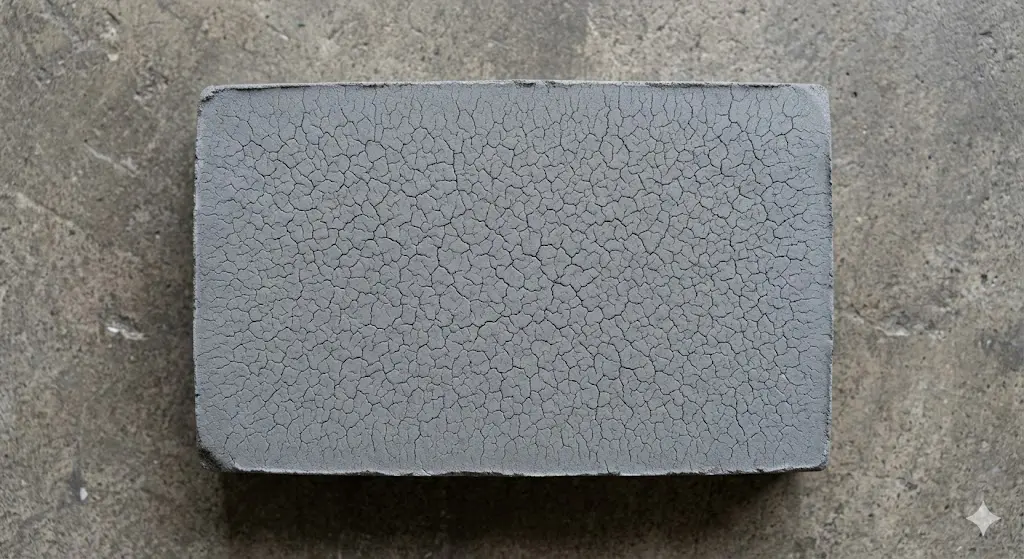
Color is the fastest diagnostic available. It requires no instruments — just a consistent eye and a reference point. Compare what you’re pulling now to what you pulled six months ago. Even a subtle shift means something has changed upstream.
Here are the four most common color presentations, what they indicate, and where to look first:
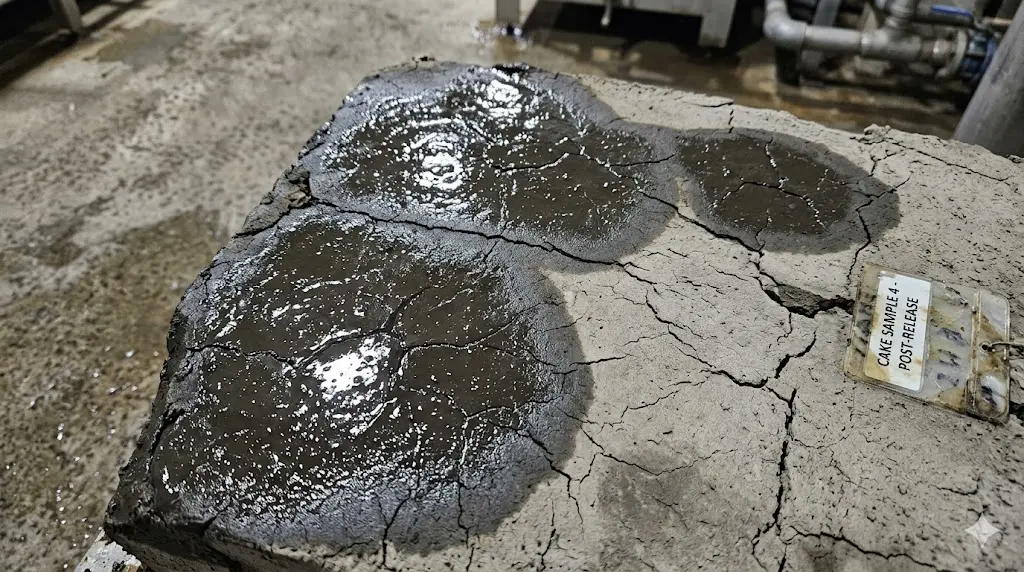
Dark, Glossy Patches
Dark, glossy areas on the cake surface indicate trapped moisture — zones the press couldn’t squeeze dry. Common causes: insufficient closing pressure (typically below 225 psi on a standard membrane press), worn gaskets allowing pressure loss between plates, or polymer underdose leaving the floc structure too weak to drain freely. Check your hydraulic pressure gauge and closing sequence log first.
Pale, Washed-Out Streaks
Light-colored streaks running through an otherwise normal cake signal channeling — the slurry found a low-resistance path and bypassed large sections of the chamber. The slurry drained there; it didn’t press everywhere else. Check for plugged feed eyes (a 15-minute inspection), cloth blinding from mineral buildup, or uneven cake thickness from a previous misaligned cycle.
Unplanned downtime
Cloth degradation, polymer drift, and pressure loss all show up in the cake weeks before they become failures. See what your operation is leaving on the table — and what planned maintenance actually saves.
Color Shift Across the Plate Stack
If cakes near the feed inlet look different from cakes at the closed end of the press, your feed pressure profile is off. The press is filling unevenly — typically a pump sizing issue, a partially obstructed feed line, or pressure drops across a long manifold run. A correctly sized pump should deliver consistent pressure throughout the fill phase.
Off-Color or Unfamiliar Tint
An unexpected color shift — a new gray-green, an orange tint, a darker baseline — means your influent chemistry has changed. A new process stream upstream, a different raw material, a seasonal shift in source water, or a new chemical addition can all alter the cake. This is the moment to re-test your influent chemistry rather than assume the press is the problem.
The Filter Cake Field Guide includes a full crack pattern reference — from tight hairlines to wide fractures — so you always have a diagnostic baseline on hand.

A practical buyer's guide for evaluating boiler water treatment programs — covering chemistry, service levels, and total cost of ownership before you sign anything.
Fill out the form for instant access.
Pick a cake up and examine the surface. The cracking pattern is one of the most reliable indicators of how well your flocculant program is working — and it’s visible without any test equipment.
Tight Hairline Cracks Running Uniformly Across the Cake
This is the target. Tight, uniform hairline cracks indicate a strong, well-conditioned floc structure that bound solids tightly during the press cycle. Polymer dose is correct, mixing energy is appropriate, and the cake compressed evenly. Filtrate should be clear at this stage.
Wide, Deep Cracks That Split the Cake Into Chunks
Wide fractures indicate over-conditioning or excessive polymer dose. The cake is brittle because the polymer bridged solids that should have stayed mobile, trapping water in pockets that escape only when the cake fractures under its own weight. Reduce polymer dose in 5–10% increments and re-test. Per TAPPI guidelines, over-flocculated sludge often shows 20–30% lower solids capture than optimally dosed sludge.
No Cracks — Soft, Putty-Like Surface
A smooth surface with no crack pattern means the floc never fully developed. Polymer is underdosed, or mixing energy is too low to activate it. The cake will be wetter than normal (often below 25% solids for municipal sludge), and filtrate is probably cloudy. Check polymer dilution water ratio and impeller speed before increasing dose.
Cracks Only at Edges, Smooth in Center
Edge-cracking with a smooth center indicates a pressure distribution problem. The periphery of the chamber dewatered; the center retained moisture longer. This is usually a sign of plate misalignment, a partially blinded cloth in the middle of the stack, or an uneven membrane inflation pattern on a membrane press. Inspect cloth condition and plate alignment across the full stack.
Use this reference table during your next cycle observation. Each combination of color, crack, and release pattern points to a specific area to investigate.
| What a Healthy Filter Press Cake Looks Like | |
|---|---|
| Trait | What to Look For |
| Uniform Thickness | Consistent depth across the full chamber, edge to center — no thin zones or void pockets |
| Consistent Color | No streaking, wet patches, or discoloration — uniform tone across the full cake face |
| Clean Release | Drops from the cloth with minimal residual material — no scraping required |
| Structural Integrity | Holds its shape when handled, breaks with a defined edge — not a smear. Solids typically 30–45% depending on sludge type. |
The moment plates separate is the most diagnostic 30 seconds of the entire cycle. The release pattern tells you the combined story of cloth condition, polymer performance, and cake structure. Watch it consistently — changes in release behavior are often the first visible symptom of a drifting program.
Cloths are healthy, polymer chemistry is matched to the sludge, and surface tension between cake and cloth is breaking cleanly. This is the target. Log the cycle time, closing pressure, and polymer dose when you see this — it’s your operating reference point.
Cloth blinding is the most common precursor to filter press downtime. Solids have embedded in the cloth weave, and the cake can’t break free. This condition develops gradually — a cake that takes slightly longer to drop becomes a cake that requires scraping, then a press that can’t complete a full cycle. Cloth washing frequency should increase before this point. Replacement is warranted when washing no longer restores release performance.
Premature cake fragmentation means cake structure is too weak to hold together as plates open. Either polymer is under-dosed, the cycle is being cut short before the cake fully consolidates, or feed solids concentration is too low to form a cohesive cake. Check cycle timing against your established consolidation period.
Next steps
ChemREADY’s dewatering team works directly with operators to interpret cake quality, tune polymer programs, and catch equipment issues before they force a shutdown. No obligation — just a second set of eyes on your operation.
This is slurry, not cake. The press completed its cycle without forming a solid cake — the most severe diagnostic outcome. Check feed solids concentration first (optimal range for most filter presses: 1–8% total suspended solids). Then verify polymer dose and cycle time. If solids are adequate and chemistry is correct, the issue may be a failed membrane or significant pressure loss.
A cake reading takes 90 seconds per cycle. Done consistently, it’s the cheapest diagnostic in your entire dewatering operation — and it surfaces problems while they’re still adjustments rather than failures. Equipment failures in filter press operations cost an average of $8,000–$25,000 in unplanned downtime and emergency service, according to dewatering maintenance surveys from filter press manufacturers.
Operators who build cake observation into their standard cycle log catch:
The Filter Cake Field Guide covers every release pattern and what it signals about cloth condition — before it turns into an unplanned shutdown.
The best dewatering operations build cake observation into their standard cycle log. Here is the five-step protocol:
None of this requires new instrumentation. It requires looking at what the press is already telling you. The cake is produced regardless — the only question is whether you read it.
If your team is already running a press and would benefit from a second set of eyes on what your cakes are showing, ChemREADY’s dewatering maintenance and support team works directly with operators to interpret cake quality, audit polymer programs, and tune chemistry to the sludge you’re actually running — not the sludge the equipment was originally specified for.
If your cakes are starting to stick, you’re already behind the curve. ChemREADY’s maintenance team helps operators get ahead of cloth degradation before it forces a crisis.