Reading Time | 10 Minutes
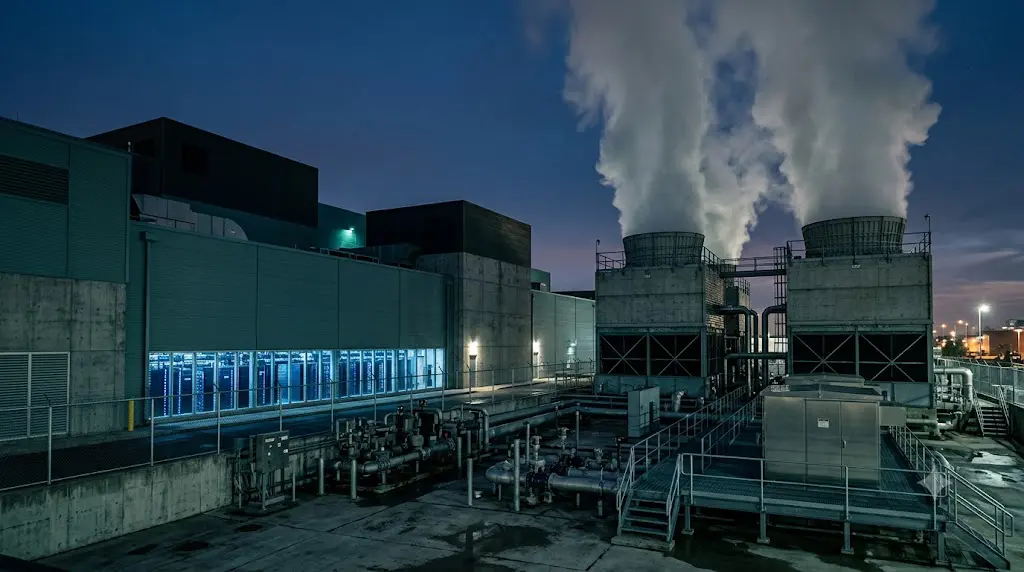
Data center cooling tower water treatment is the ongoing management of recirculating water chemistry to prevent scale, corrosion, biological growth, and fouling in open cooling systems. It involves regular testing, chemical dosing, automated monitoring, blowdown management, and documented field service to protect equipment, reduce energy costs, and maintain regulatory compliance.
A data center cooling tower evaporates water to carry heat away from equipment running around the clock. As water evaporates, minerals concentrate in the system. Without active management, those minerals form scale on heat exchange surfaces, biocide chemistry drifts out of range, and microorganisms — including Legionella — find a hospitable environment.
For a typical commercial building, these are manageable nuisances. For a facility running 24/7 under constant thermal load, any one of them is a direct threat to system reliability.
Scale is an insulator. Even 1/32 of an inch of scale on a heat exchanger surface increases energy consumption by 10–15% (U.S. DOE), and forces the chiller to work harder against resistance that doesn’t show up on any sensor. The equipment doesn’t fail immediately — it degrades, quietly and expensively, until it does.
Corrosion is slower and harder to see. Pipes thin. Fittings weaken. Heat exchangers develop pinhole leaks that become emergency shutdowns. The damage is gradual and invisible until it becomes a repair bill — or an outage that no redundancy plan accounts for because the failure mode wasn’t on anyone’s radar.
Biological fouling cuts cooling capacity precisely when you need it most: on the hottest days, when IT load is at its peak. Biofilm on fill media reduces evaporative efficiency. Legionella in poorly maintained systems creates regulatory and liability exposure that most data center operators are not positioned to manage when it surfaces.
These problems compound each other and don’t announce themselves until something fails.
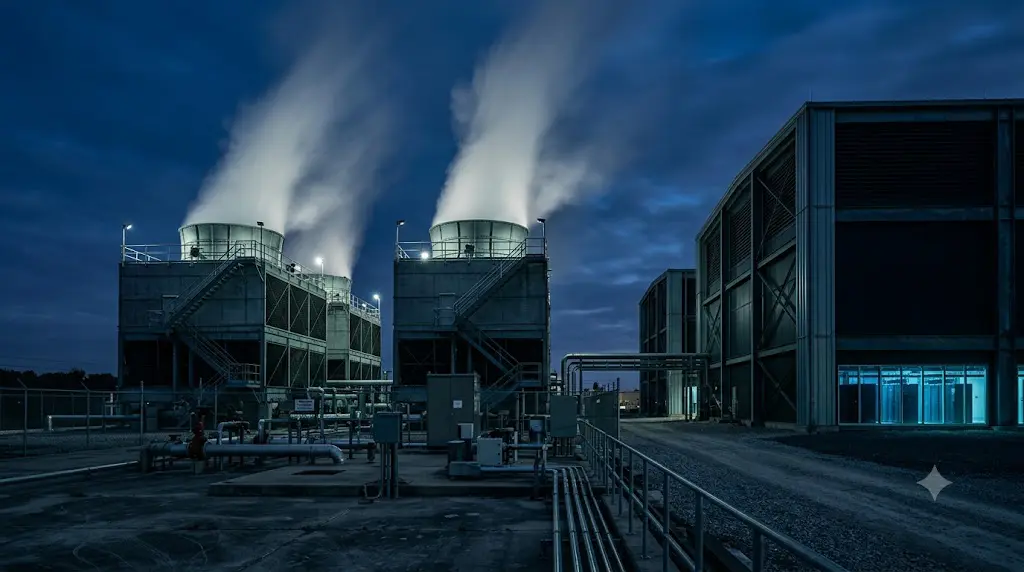
Scale, corrosion, and Legionella don't announce themselves before they become outage events. ChemREADY manages cooling tower water programs built around uptime — not calendar schedules.
A managed cooling tower program tests and controls these parameters on a regular schedule. Drift in any one of them compounds into the failure modes described above.
| Parameter | Target Range | Why It Matters | What Happens When It Drifts |
|---|---|---|---|
| pH | 7.0 – 9.0 | Controls corrosion and scale balance | Below 7.0: corrosion accelerates. Above 9.0: scale deposits increase. |
| Conductivity / TDS | 1,000–2,500 µS/cm | Indicates cycles of concentration | Too high: scaling risk. Too low: water wasted, program cost rises. |
| Cycles of Concentration | 3 – 6 | Efficiency and blowdown control | Too high: hardness ions concentrate and deposit. Too low: inefficient water use. |
| Langelier Saturation Index | −0.5 to +0.5 | Predicts scale or corrosion tendency | Positive: scaling tendency. Negative: corrosive tendency. |
| Inhibitor Residuals | Per product spec | Confirms chemistry is active in system | Below spec: protection gap. Above spec: wasted chemistry cost. |
| Biocide Residuals | Per product spec | Confirms biological control is active | Below spec: biofouling and Legionella risk window opens. |
| Microbial Count | <1,000 CFU/mL HPC | Biological risk indicator | Above threshold: immediate corrective action required per ASHRAE 188. |
Scale, corrosion, and Legionella don't announce themselves before they become outage events. ChemREADY manages cooling tower water programs built around uptime — not calendar schedules.
ASHRAE 188 is the ANSI/ASHRAE Standard 188 — Legionellosis: Risk Management for Building Water Systems. It applies to any building with cooling towers, decorative fountains, hot tubs, or complex water systems — which includes virtually every data center with an open cooling tower. Compliance requires a documented Water Management Plan (WMP) that identifies Legionella risk, establishes control measures, validates those measures, and maintains records.
Most data center operators know about Legionella in the abstract. Fewer have confirmed whether their facility has a compliant WMP in place. The CDC estimates Legionella cases have increased more than 400% since 2000, and regulatory scrutiny has increased accordingly. A gap in your water management documentation is not a technical problem — it is a liability exposure.
A compliant ASHRAE 188 program for a data center cooling tower includes a written WMP, defined control limits for each water system, regular testing and documentation, and a trained team member or contracted partner responsible for implementation.

ASHRAE 188 is the ANSI/ASHRAE Standard 188 — Legionellosis: Risk Management for Building Water Systems. It applies to any building with cooling towers, decorative fountains, hot tubs, or complex water systems — which includes virtually every data center with an open cooling tower. Compliance requires a documented Water Management Plan (WMP) that identifies Legionella risk, establishes control measures, validates those measures, and maintains records.
Most data center operators know about Legionella in the abstract. Fewer have confirmed whether their facility has a compliant WMP in place. The CDC estimates Legionella cases have increased more than 400% since 2000, and regulatory scrutiny has increased accordingly. A gap in your water management documentation is not a technical problem — it is a liability exposure.
A compliant ASHRAE 188 program for a data center cooling tower includes a written WMP, defined control limits for each water system, regular testing and documentation, and a trained team member or contracted partner responsible for implementation.
There is a difference between a chemical delivery and a water treatment program. A lot of facilities have the first and think they have the second. A drum of chemical applied on a calendar schedule leaves most of the risk unmanaged.
A real program for a data center cooling tower includes:
That last point is where most programs fall short. Scale buildup, early corrosion, a controller drifting off setpoint: these are visible to trained eyes on a routine visit. They go unnoticed — until there is a problem to react to — when nobody is showing up to look.
Scale, corrosion, and Legionella don't announce themselves before they become outage events. ChemREADY manages cooling tower water programs built around uptime — not calendar schedules.
A managed water treatment program for a data center cooling tower typically runs $800–$3,000 per month, depending on system size, water quality, program scope, and monitoring level. That range includes chemical supply, monthly or bi-monthly service visits, water analysis, and compliance documentation.
The cost of not having a program is harder to calculate but easier to feel. A single heat exchanger failure at a data center can run $50,000–$200,000 in parts, labor, and emergency response — before accounting for downtime. Legionella remediation for a commercial facility averages $30,000–$100,000. A scale-driven chiller efficiency loss of 15% on a 1,000-ton system adds $30,000–$60,000 per year in energy cost.
The math is not complicated once you run it. The question is whether you’re running it before or after the first incident.
Five indicators that a data center water treatment program is actually performing:
If you can’t confirm all five, the program has gaps worth closing before they become failures worth managing.
Cooling water treatment is not a facilities expense. It is uptime insurance. Scale reduces chiller efficiency and strains equipment. Corrosion causes leaks that trigger emergency shutdowns. Biological fouling cuts capacity when demand peaks. Legionella creates liability exposure most data center operators aren’t positioned to manage when it surfaces.
A managed cooling tower water treatment program costs a fraction of what a single unplanned outage costs. ChemREADY manages water programs for data centers and mission-critical facilities — including chemistry, monitoring, Legionella compliance, and proactive field service. Your team doesn’t need to become water chemistry experts. That’s what we’re here for.
Book a 30-minute conversation directly. We'll discuss your water treatment situation and whether working together makes sense.
Book a 30-minute call →Take a look at our water treatment services first. See where you stand across chemical programs, system performance, and municipal compliance — then decide if a conversation makes sense.
Find out what a buyer would see →Browse everything we do in water treatment — chemicals, equipment, and services — at your own pace, no conversation required.
Explore our water treatment solutions →We work with advisors who encounter infrastructure gaps in municipal water and drinking water client businesses. If you're looking for a referral partner for pre-sale readiness work, let's talk.
Learn about our partner program →