Reading Time | 12 Minutes
There is a number your cooling tower is producing right now that most facility managers have never seen. It is not buried in a maintenance log or hidden inside a vendor report. It is happening in the water itself. And if it is wrong, it is draining money out of your budget in three directions simultaneously: your water bill, your chemical spend, and your energy costs.
That number is your cycles of concentration.
In facilities where it is not actively managed, the annual waste typically runs between $12,000 and $25,000. This is not a theoretical problem. It is happening right now, in cooling towers across the country, because no one ever showed the people running those systems how the math actually works.
Target ranges vary by water hardness, silica levels, and metallurgy. Download the free CoC Reference Card — formula, blowdown math, and target ranges by water type on one printable page.
When water evaporates from your cooling tower, it leaves behind everything it was carrying: minerals, dissolved solids, salts. The water that stays in the system gets progressively more concentrated with each evaporation cycle.
The CoC formula is simple: Tower Water Conductivity ÷ Makeup Water Conductivity = Cycles of Concentration. If your makeup water has 200 ppm of dissolved solids and your tower water has 800 ppm, you are running at 4 cycles.
That ratio controls three things simultaneously:
Cycles of concentration (CoC) is the ratio of dissolved solids in cooling tower recirculating water compared to dissolved solids in the makeup water supply. A CoC of 4 means the tower water is four times as concentrated as the water coming in. This ratio directly controls blowdown frequency, chemical consumption, and the aggressiveness of water chemistry toward equipment.
Cycles of concentration is the single most important operating parameter in cooling tower water chemistry. Every other treatment decision — inhibitor dosing, blowdown frequency, biocide programs — is downstream of this number. Get CoC wrong and the entire program is compensating for a problem that did not need to exist.
Most facilities are not managing it. They are guessing, or worse, leaving it on a default setting that has never been validated against their actual makeup water quality, load, or equipment.
This is by far the more common problem. It shows up when a facility is blowing down too aggressively — dumping treated water before it has been concentrated to its safe, useful limit.
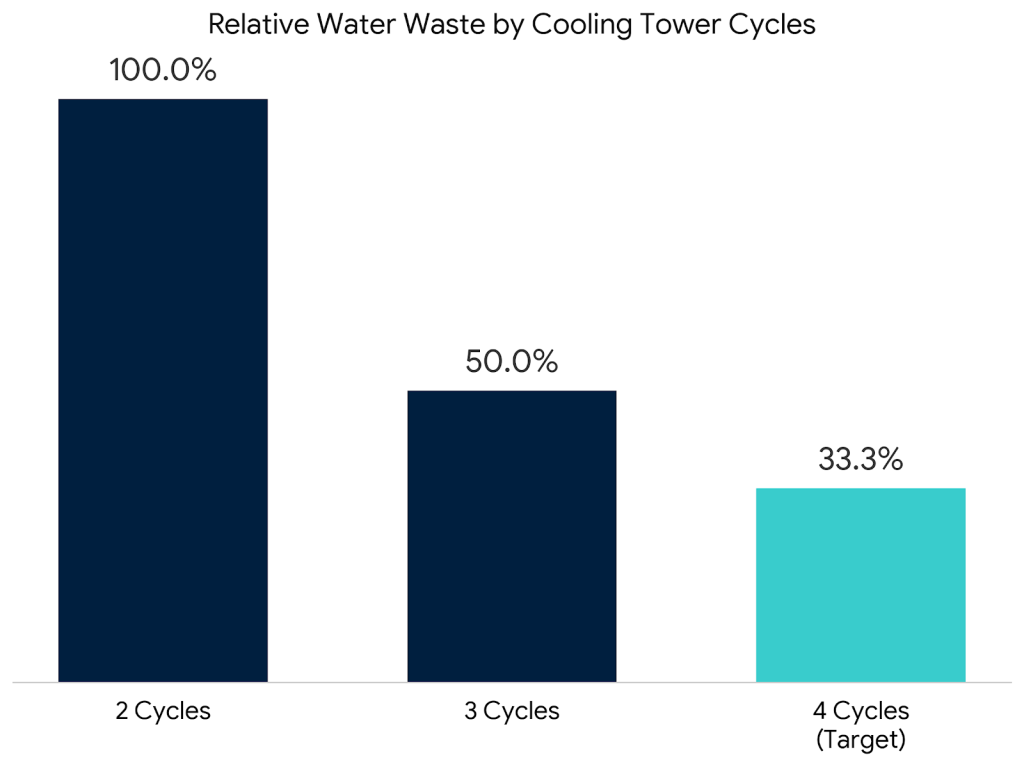
Running at 2 cycles instead of the 4-cycle target most systems can safely achieve means throwing away 50% of your tower water as blowdown. At 4 cycles, that drops to 25%. For a mid-size industrial facility with a 400-ton cooling tower running 6,000 hours per year:
| CoC Setting | Blowdown % | Annual Water Wasted | Chemical Cost Impact | Energy Efficiency |
|---|---|---|---|---|
| 2 Cycles | 50% | ~3.6M gal/yr | Severe chemical overdose | Baseline |
| 3 Cycles | 33% | ~2.4M gal/yr | 25% reduction vs. 2x | Improving |
| 4 Cycles ✓ Target | 25% | ~1.8M gal/yr | 50% reduction vs. 2x | Near optimal |
| 6 Cycles | 17% | ~1.2M gal/yr | Requires scale guard | Scale risk rises |
| 8+ Cycles | 13% | ~900K gal/yr | High scale/corrosion risk | System risk |
Assumptions: 400-ton tower, 6,000 operating hours/year, makeup water at $0.004/gal, chemical costs scaled to blowdown rate.
The water cost gap between running at 2 cycles and 4 cycles is roughly 1.8 million gallons per year. At typical municipal water rates, that is between $7,000 and $12,000 annually. Simply because blowdown was not optimized.
Now add chemical costs. When blowing down at twice the necessary rate, you flush corrosion inhibitors, biocides, and scale control chemistry at the same rate. Dosing costs run 30–50% above what a properly cycled system requires.
And then there is energy. The U.S. Department of Energy has documented that a scale deposit of just 1/32 inch on heat exchanger surfaces increases energy consumption by 10–15%. Systems running low cycles accumulate minor scale faster, and that scale bleeds energy costs every hour the system runs.
Add those three losses together on a system running at 2 cycles when it should be at 4 — $18,000 annually is a conservative estimate. For larger systems or higher water costs, it climbs considerably higher.
The opposite error is less common but more immediately damaging. When cycles run too high without appropriate chemistry adjustments, dissolved mineral concentrations exceed the solubility limits of calcium carbonate, calcium sulfate, and silica. Scale deposits form rapidly on heat transfer surfaces.
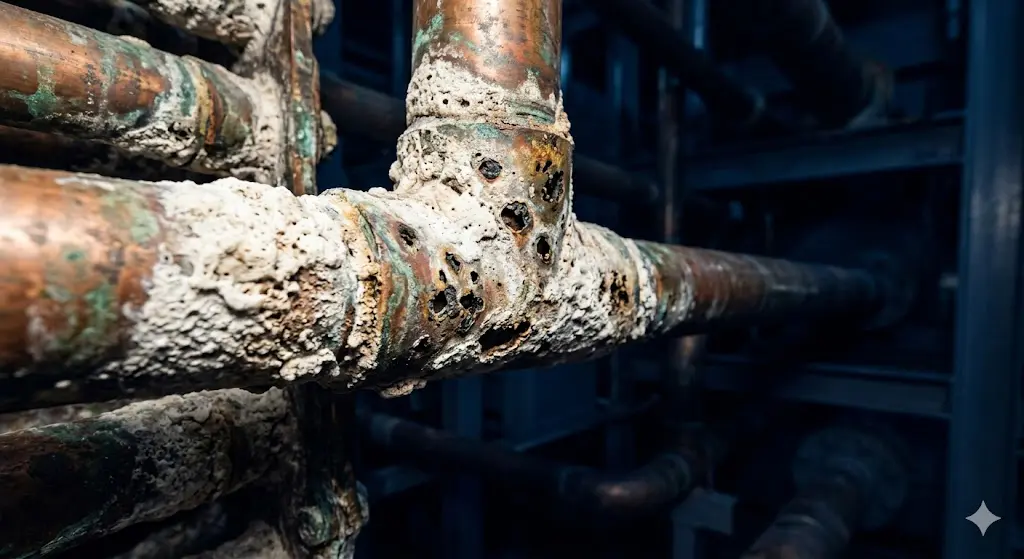
High-cycle operation without proper scale and corrosion inhibitor management creates aggressive water chemistry that attacks pipe walls, heat exchangers, and tower structure. Corrosion rates accelerate. Equipment life shortens. And the damage is cumulative — each season of unmanaged high-cycle operation leaves the system in worse condition than the last.
Warning sign: If your tower water has visible cloudiness, white deposits on fill media, or unusual odor — and your service provider cannot immediately tell you your current CoC and target range — you likely have an unmanaged cycles problem.
The right answer is not “run cycles as high as possible” or “blow down aggressively to be safe.” The right answer is a specific, validated target range — determined by your makeup water quality, system metallurgy, and load profile — monitored continuously and adjusted in real time.
The CoC Reference Card includes the calculation, blowdown rate math, target ranges by water type, and the six red flags your program should never hit — one page, free download.

A practical buyer's guide for evaluating boiler water treatment programs — covering chemistry, service levels, and total cost of ownership before you sign anything.
Fill out the form for instant access.
Every cooling tower system has a different optimal cycle range. The number is not arbitrary and it is not something a vendor should be guessing at. It is calculated from three inputs:
The LSI is particularly important. An LSI of 0 indicates balanced water. Positive values indicate scale-forming conditions; negative values indicate corrosive conditions. Your CoC target must keep the LSI within a manageable range — typically between -0.5 and +0.5 — for the full operating temperature range of your system.
A proper water analysis — not just a conductivity measurement — is the starting point for any legitimate CoC program. ChemREADY’s cooling tower water treatment programs begin with a full makeup water analysis and LSI calculation to establish the safe operating envelope before a CoC target is ever set.
Once that target is established, the program holds it through two mechanisms: automated blowdown control that maintains conductivity within a set range, and monitoring systems that alert when chemistry drifts. This is where controllers and automation become operationally significant. Manual blowdown — where a maintenance tech opens a valve on a schedule — is inherently imprecise. Automated conductivity-based blowdown holds cycles within a tight band and eliminates the guesswork.
Cycles of concentration is not a monthly check. It is a daily, sometimes hourly, variable. Load swings as process demand changes. Makeup water quality varies with municipal supply changes and seasonal fluctuations. Any of these moves your actual CoC away from target, and the drift happens continuously — not on a service schedule.
If your water treatment provider visits once a month, that is 29 days of unmonitored operation between each check. In a system without automated controls, cycles can drift from 4 to 2 (wasting water and chemistry) or from 4 to 7+ (building scale and accelerating corrosion) without anyone knowing. Both directions cost money. One of them costs equipment.
This is the core case for digital remote monitoring in a cooling tower program. Real-time conductivity tracking, automated alerts when chemistry leaves the target range, and data logging that gives your service team full visibility into what the system has been doing since the last visit — not just what it looks like right now.
The full blowdown table, target ranges, red flag checklist, and three questions to ask your vendor — condensed to one page.
You do not need to overhaul your entire water treatment program to find out where you stand. You need three pieces of information:
Ask your water treatment provider for the most recent conductivity reading from your tower water and your makeup water. Divide tower conductivity by makeup conductivity. That is your CoC. If your provider cannot give you both numbers on the spot, that tells you something important about the level of management you are receiving.
Your program should have a written CoC target range — not a rough guideline, but a specific range with a documented basis in your makeup water analysis. If that document does not exist, your program does not have a foundation.
Use the Cooling Tower Savings Calculator to see what the difference between your current CoC and your optimal target is costing you annually in water, chemicals, and energy.
One question worth asking your current provider: “What is our CoC target, and what is it based on?” If the answer is vague, or if they have to look it up, or if they cannot connect it to a water analysis — you are running a program without a foundation.
ChemREADY’s cooling tower services are built around this kind of documented, validated program management: a defined CoC target based on your actual makeup water, automated or monitored blowdown control, and monthly service visits with full data context — not just a sample and a report.
The reference card includes three specific questions — and what a good answer actually looks like.