Reading Time | 6 Minutes
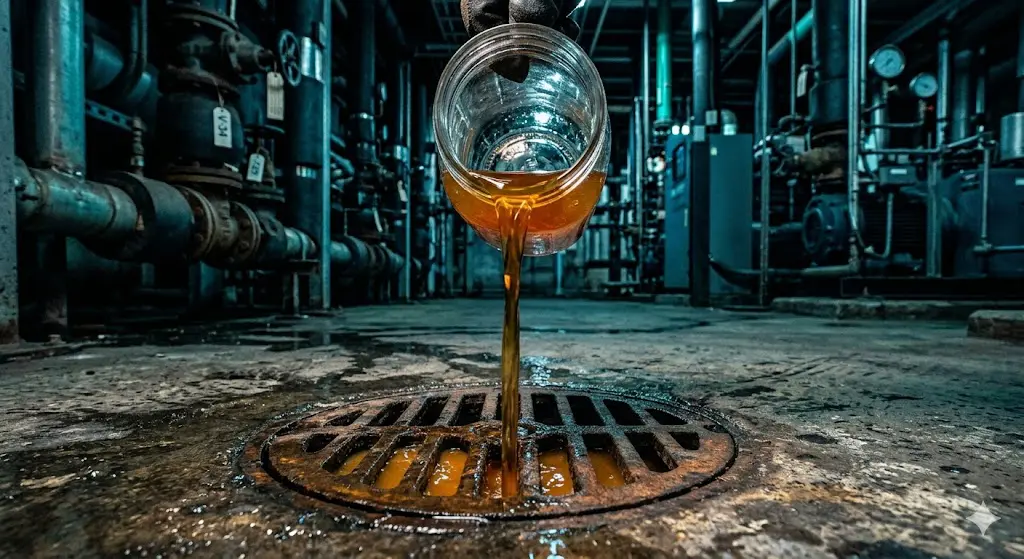
Every spring, thousands of industrial boilers get drained without anyone looking twice at what comes out. That’s a mistake. The water leaving your boiler at shutdown carries a complete chemical record of the heating season — corrosion activity, scale formation, treatment gaps, and oxygen exposure. If you know what to look for, it takes five minutes to read. And what you learn can save you from a very expensive fall startup.
Boiler drain water analysis — the systematic observation of color, clarity, odor, and pH at seasonal shutdown — is one of the lowest-effort, highest-return maintenance practices available to facility teams. Most skip it entirely.
Download ChemREADY’s free Boiler Shutdown Drain Water Checklist — what each color means, what odors signal, what pH to record, and when to call before you button up for the season. One page. Field-ready.
Your boiler has been running all heating season. Water has cycled through it thousands of times. Minerals have concentrated. Treatment chemistry has drifted. Corrosion products and sludge have accumulated. All of that ends up suspended in the drain water when you shut down.
Most facility teams watch that water run and walk away. The teams that stop and actually evaluate it — systematically, before buttoning everything up for the off-season — are the ones who catch problems now instead of in October. Here’s what each observation tells you and what to do about it.
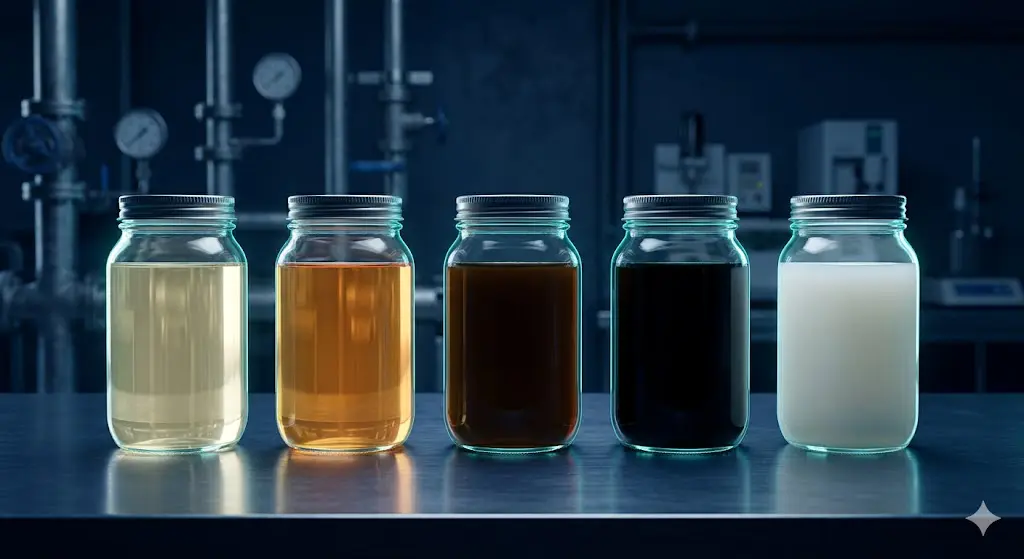
Boiler drain water color is a direct indicator of corrosion activity, sludge accumulation, and treatment program effectiveness. Clear or pale straw-colored water signals a well-performing program. Orange or amber indicates iron oxide from corrosion. Dark brown signals heavy sludge. Black water — the most serious finding — indicates magnetite breakdown in the protective oxide layer.
Hold a clear container under the drain and evaluate the color in daylight. Here is what each color means in practical terms:
Pale straw or lightly tinted: Your baseline normal. Corrosion products are low, sludge is minimal, and the system enters layup in good condition. Your boiler water treatment program did what it was supposed to do this season.
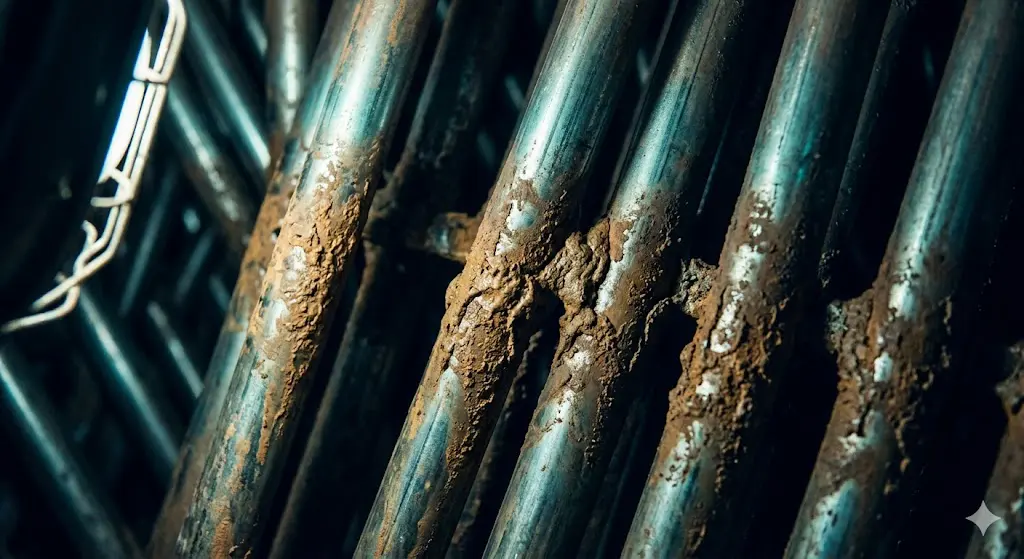
Orange or amber: Iron oxide is in suspension. Corrosion occurred somewhere in the system — the boiler itself, the feedwater circuit, or a condensate return line. Light amber is a flag. Deep rust-colored water is a flag requiring a program review before next season. Iron levels above 2–3 ppm in operating boiler water typically indicate active corrosion that a correctly dosed program should be suppressing.
Dark brown: Heavy sludge load. Your sludge conditioner was under-dosed, your blowdown frequency was insufficient, or both. When sludge accumulates to the point of producing dark brown drain water, a portion of that material has almost certainly settled on tube surfaces and begun to thermally bake in — reducing heat transfer and creating localized overheating risk. Get an inspection before layup.
Black: Magnetite (Fe₃O₄) in suspension. Magnetite is the protective oxide layer that forms on carbon steel. Seeing it in drain water means that layer has been mechanically or chemically disrupted — most commonly from oxygen ingress, treatment chemistry failure, or thermal stress events. Black drain water is the highest-urgency finding on this list and warrants professional inspection before any layup chemistry is added.
Milky or cloudy: Oil contamination from a failed mechanical seal or pump, carryover from a chemistry imbalance, or in rare cases, biological activity in the feedwater. Do not write this off as a visual artifact. Pull a sample, let it separate, and send it for analysis before you proceed with layup.
Color, clarity, odor, pH — ChemREADY’s Boiler Shutdown Drain Water Guide walks you through every observation, what it means, and what to do before you walk away for the season.
A practical buyer's guide for evaluating boiler water treatment programs — covering chemistry, service levels, and total cost of ownership before you sign anything.
Fill out the form for instant access.
Boiler drain water clarity indicates whether contaminants are dissolved or particulate. Clear but colored water signals dissolved compounds — typically iron. Turbid, cloudy, or visibly chunky water signals suspended particles — sludge, scale fragments, or colloids — that your blowdown program should have been removing throughout the season.
Color and clarity are separate diagnostic signals. Observe both independently.
Visible flakes or chunks in drain water are the most urgent clarity finding. They do not indicate self-cleaning. They indicate that scale or tube deposits have built up to the point where mechanical stress — thermal cycling — is physically fracturing them. That material is now sitting somewhere in your system.
Turbid water that settles quickly in a jar (within 2–3 minutes) suggests coarse sludge — the type your blowdown schedule should remove. Water that remains uniformly cloudy after 5 minutes indicates colloidal material, which points to chemistry-level problems, not just blowdown frequency.
The clarity test takes two minutes: fill a clear glass jar at the drain, hold it up to light, and wait five minutes. Note what settles, how fast, what color the settled layer is, and what the water looks like above it. Photograph it. That record compounds in value every year you maintain it.
A sulfur or rotten-egg odor in boiler drain water indicates the presence of sulfate-reducing bacteria (SRB) in the feedwater system or condensate return lines. These anaerobic organisms produce hydrogen sulfide gas as a metabolic byproduct and accelerate corrosion significantly. SRB do not require oxygen to survive and will persist through the off-season unless actively treated.
| Odor | What It Suggests | Urgency |
|---|---|---|
| Sulfur / rotten egg | Sulfate-reducing bacteria (SRB) in the feedwater or condensate system. These organisms produce hydrogen sulfide and accelerate corrosion significantly. | High |
| Petroleum / chemical | Oil contamination from a pump seal, heat exchanger, or process crossover. Oil in boiler water causes foaming and carryover and can deposit on tube surfaces. | High |
| Musty / organic | Biological activity in the feedwater or return lines. Less common in high-temperature steam systems but possible in lower-pressure units. | Moderate |
| Ammonia | Often from amines used in condensate return treatment. Elevated ammonia odor can indicate over-treatment or a return system issue. Usually not dangerous but worth noting. | Low-Moderate |
| Hot water / neutral | Normal. No significant biological or chemical contamination present. | Normal |
Sulfur odor requires immediate pre-layup treatment. SRB establish colonies in biofilm on pipe surfaces and in tank sediment. They survive dry periods and reactivate at startup. A biocide shock treatment — typically with sodium hypochlorite at 5–10 ppm free chlorine or an appropriate non-oxidizing biocide — followed by a thorough flush before layup chemistry is added is the minimum response. Contact your water treatment provider before applying any biocide to a pressurized system.
If your drain water was orange, brown, black, or smelled like sulfur — don’t just proceed with standard layup. ChemREADY’s team can review your findings and tell you exactly what your boiler needs before the off-season.
Boiler drain water pH at shutdown should measure between 10.5 and 11.8 for most industrial boilers operating below 300 psi, reflecting the alkalinity maintained throughout the operating season. A reading below 9.5 indicates alkalinity depletion — a corrosion setup heading into layup. A reading above 12.5 indicates over-treatment with alkalinity builders.
If you have a test kit on-site — and you should — pull pH before the drain water is gone. This is one of the most actionable data points available at shutdown.
pH below 9.5: Your alkalinity was depleted during the season. Common causes include CO₂ ingress from incomplete deaeration, condensate contamination lowering return water pH, or insufficient dosing of alkalinity builders (sodium hydroxide, sodium carbonate, or sodium bicarbonate, depending on your program). Low pH going into layup means metal surfaces have inadequate chemical protection for the entire off-season — months of idle time with no corrosion inhibitor replenishment. Correct this before completing layup, not after.
pH 10.5–11.8: Target range. Your alkalinity program performed as intended. Use this reading as a baseline for your layup chemistry calculation if you’re doing wet layup.
pH above 12.5: Your program was running high on alkalinity builders — adding cost without additional corrosion protection benefit and potentially contributing to caustic embrittlement risk in older boilers. Review dosing with your provider before next season.
The drain water pH is a direct input to your layup chemistry decision. For wet layup, you’re targeting pH 10.5–11.5 in the sealed system, with oxygen scavenger (sodium sulfite at 200–400 ppm excess or DEHA at 100–200 ppm) added to eliminate dissolved oxygen. If your drain water pH is already at the low end of acceptable, account for that in your layup dosing — you’re starting from a deficit.
Black water. Sulfur smell. pH below 9.5. If any of those match what you saw at drain, don’t wait until startup to find out what it means. ChemREADY’s specialists are available now.
No single observation tells the complete story. What matters is the pattern — and whether the combination of findings points to a treatment program that performed or one with gaps to address before next season.
| What You See | What It Means | What to Do |
|---|---|---|
| Pale, clear, neutral smell, pH in range | Treatment program performed well. System is in good condition for layup. | Proceed with layup per your normal protocol. Document results. |
| Light amber, slightly turbid, pH low-normal | Some iron activity and chemistry drift. Treatment was working but not dialed in perfectly. | Review corrosion inhibitor dose and blowdown frequency for next season. Adjust alkalinity before layup. |
| Orange/brown, turbid, high sludge | Significant corrosion activity and sludge accumulation. Treatment program has gaps. | Get an inspection before layup. Review entire treatment program for next season. Consider a program audit. |
| Black water, any smell, low pH | Magnetite breakdown, possible oxygen ingress, chemistry failure. Highest-risk finding. | Do not proceed with standard layup. Get a professional inspection. This system needs attention before shutdown. |
| Any sulfur smell, regardless of color | Biological activity in the system. Will not resolve on its own over the off-season. | Treat for SRB before layup. Inspect feedwater and return system. Contact your water treatment provider. |
Whatever your drain water tells you, the most consequential decision you make right now is the layup chemistry you seal into that system.
For wet layup: The chemistry you add at shutdown is what protects the metal surfaces from oxygen corrosion for the entire off-season. The minimum effective wet layup protocol includes maintaining pH at 10.5–11.5 and eliminating dissolved oxygen with a scavenger dosed to 200–400 ppm excess sodium sulfite (or 100–200 ppm DEHA for volatile oxygen scavenger programs). The system must be fully flooded and sealed.
For dry layup: Quality of drying matters more than chemistry. The objective is removing all water from tube surfaces before oxygen can create concentration cells. Silica gel desiccant trays are standard for fireside protection. Nitrogen blanketing is the most reliable option for waterside protection in dry layup.
If your drain water flagged problems — low pH, iron activity, biological odor — those problems don’t pause while the boiler is offline. They either get corrected in the layup protocol or they’re waiting for you at October startup.
Read the full guide on pre-shutdown blowdown protocols and how the two weeks before shutdown determine layup quality. See also: wet vs. dry layup chemistry requirements and how drain water pH affects your off-season protection calculation.
Book a 30-minute conversation directly. We'll discuss your water treatment situation and whether working together makes sense.
Book a 30-minute call →Take a look at our water treatment services first. See where you stand across chemical programs, system performance, and municipal compliance — then decide if a conversation makes sense.
Find out what a buyer would see →Browse everything we do in water treatment — chemicals, equipment, and services — at your own pace, no conversation required.
Explore our water treatment solutions →We work with advisors who encounter infrastructure gaps in municipal water and drinking water client businesses. If you're looking for a referral partner for pre-sale readiness work, let's talk.
Learn about our partner program →