“Scale, corrosion, sediment controls, and system cleaning are critical and disinfectant residual should be adjusted by an automated system”
“The most common cause of overheating and failure of boiler tubes is the formation of hard scale.”
“Removing biofilm could decrease energy costs by 30%. Do you have the right chemicals for your system?”
“The bane of cooling towers is suspended solids which concentrate in direct proportion to the cycles of concentration.”
Abilene is home to an established industrial and commercial base that includes military operations (dyess air force base), higher education (abilene christian, hardin-simmons, mcmurry), healthcare (hendrick health), oil field services, manufacturing, and wind energy operations. Each of these sectors relies on water-dependent systems — cooling towers, boilers, closed-loop circuits, and process water — that must perform efficiently to avoid unplanned downtime, premature equipment replacement, and regulatory non-compliance. Professional water treatment is the difference between a system that runs for 20 years and one that fails in five.
The local water supply in Abilene is sourced from surface (fort phantom hill lake, hubbard creek reservoir, o.h. ivie reservoir via city of abilene), which produces water with very hard (200-350 ppm) hardness levels. This elevated hardness is the primary driver of scaling problems in Abilene cooling towers and boilers. Calcium carbonate and silica deposits accumulate on heat transfer surfaces, reducing thermal efficiency by up to 30% and forcing increased energy consumption to maintain setpoints. Without a professionally engineered chemical program that adapts to seasonal source water changes, facilities on Abilene water face accelerating maintenance cycles and shortened equipment life.
Abilene falls under TCEQ Region 3 (Abilene), which oversees all environmental permitting and compliance in the area. TCEQ Region 3 is headquartered in Abilene itself, creating an intensely local regulatory environment where TCEQ inspectors are physically close to every permitted facility. Water scarcity is a defining characteristic of the Abilene area — the city has experienced multiple severe droughts and implemented mandatory water restrictions — making water conservation and treatment optimization critical for both economic and environmental reasons. EnviroTech’s water treatment programs are engineered to optimize system performance while keeping your facility’s discharge water quality within all applicable TPDES and local pretreatment limits. We handle the compliance documentation so your team can focus on operations.
EnviroTech’s Abilene service team delivers the full range of water treatment services to commercial and industrial facilities across Taylor County and the surrounding area. Every program is designed by Certified Water Technologists and supported by local technicians who understand Abilene’s specific water chemistry and regulatory requirements.
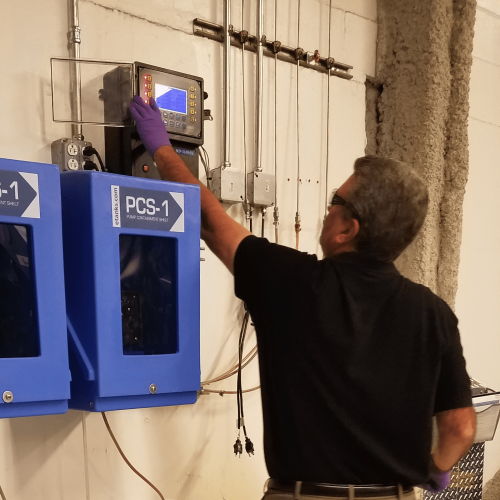
Our process starts with understanding your facility before prescribing solutions:
Q: How much does industrial water treatment cost in Abilene?
Water treatment in Abilene typically runs $500–$5,000/month depending on system count, water chemistry, and program complexity. The hard water from surface (fort phantom hill lake, hubbard creek reservoir, o.h. ivie reservoir via city of abilene) often requires more aggressive chemistry, pushing costs toward the upper range for multi-system facilities. EnviroTech provides free on-site assessments with transparent pricing.
Q: What are the water hardness levels in Abilene?
Abilene’s water from surface (fort phantom hill lake, hubbard creek reservoir, o.h. ivie reservoir via city of abilene) produces very hard (200-350 ppm) hardness — primarily calcium and magnesium carbonates creating scaling potential in cooling systems and boilers. Hardness fluctuates seasonally with reservoir conditions and source blending. EnviroTech monitors these shifts and adjusts your program proactively.
Q: How often should cooling towers be tested in Abilene?
Weekly minimum for basic parameters (conductivity, pH, biocide residual). Monthly for comprehensive analysis (hardness, alkalinity, silica, iron, bacteria counts). Texas’s extended warm season accelerates biological growth, often warranting increased testing frequency from April through October. All testing is included in EnviroTech’s service program.
Q: What Abilene industries need water treatment?
Abilene’s industries — military operations (dyess air force base), higher education (abilene christian, hardin-simmons, mcmurry), healthcare (hendrick health), oil field services, manufacturing, and wind energy operations — all rely on professional water treatment. Any facility with cooling towers, steam boilers, closed-loop HVAC, or process water systems benefits from a managed program. Healthcare, data centers, and food processing have the most critical requirements.
Q: Which TCEQ region covers Abilene?
Abilene falls under TCEQ Region 3 (Abilene). TCEQ Region 3 is headquartered in Abilene itself, creating an intensely local regulatory environment where TCEQ inspectors are physically close to every permitted facility. Water scarcity is a defining characteristic of the Abilene area — the city has experienced multiple severe droughts and implemented mandatory water restrictions — making water conservation and treatment optimization critical for both economic and environmental reasons. EnviroTech maintains relationships with regional TCEQ staff and assists with permit compliance and regulatory communications.
EnviroTech provides water treatment services throughout Taylor County and surrounding areas. Our Fort Worth service team also serves:
Dyess AFB · Buffalo Gap · Tuscola · Sweetwater · San Angelo · Brownwood · Stephenville · Eastland · Cisco
7620 Flagstone St, Fort Worth, TX 76118, USA
(574) 254-0275
F: 330-425-8202
sales@getchemready.com
