Reading Time | 4 Minutes
Most chilled water loops restart in spring with a simple assumption: the water inside is more or less the same water that went in last fall. Facilities turn on the chiller, watch the differential pressure, listen for unusual noises, and move on.
That assumption is wrong.
By the time symptoms show up — a plugged strainer, a seized pump, a leaking coil — the damage has already been done over months of dormancy, not days of operation. Understanding what is actually building up inside your loop, and why, changes how you approach spring startup entirely. You stop treating it as a checkbox and start treating it as a diagnostic opportunity.
The Chilled Loop Water Analysis Guide shows you exactly what each test parameter means, what the target ranges are, and what out-of-range numbers tell you about what’s been happening inside your system.
Oxygen ingress, pH drift, and depleted inhibitor are the three things quietly eating your loop. ChemREADY’s closed loop treatment chemicals are formulated to stop all three — and our service team monitors the numbers so you don’t have to.
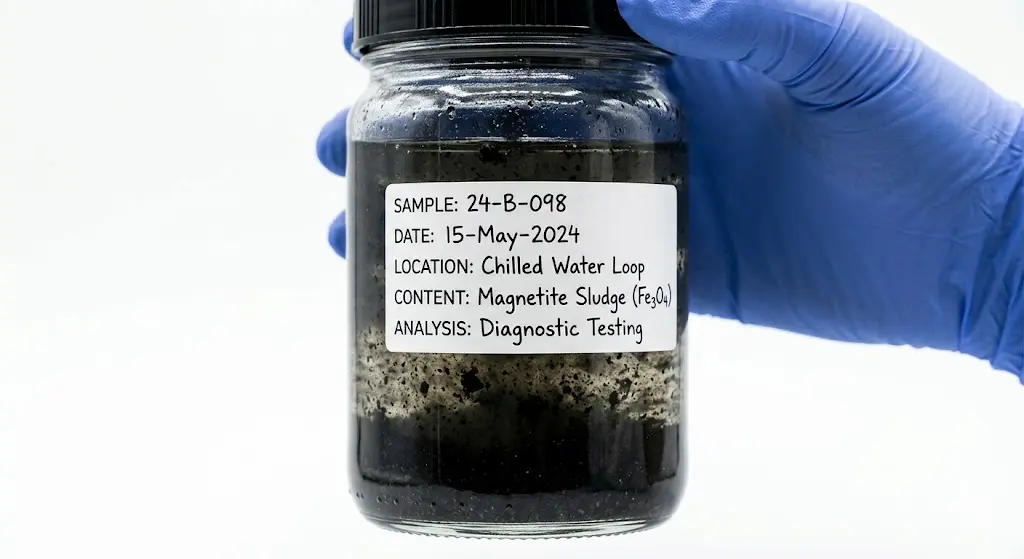
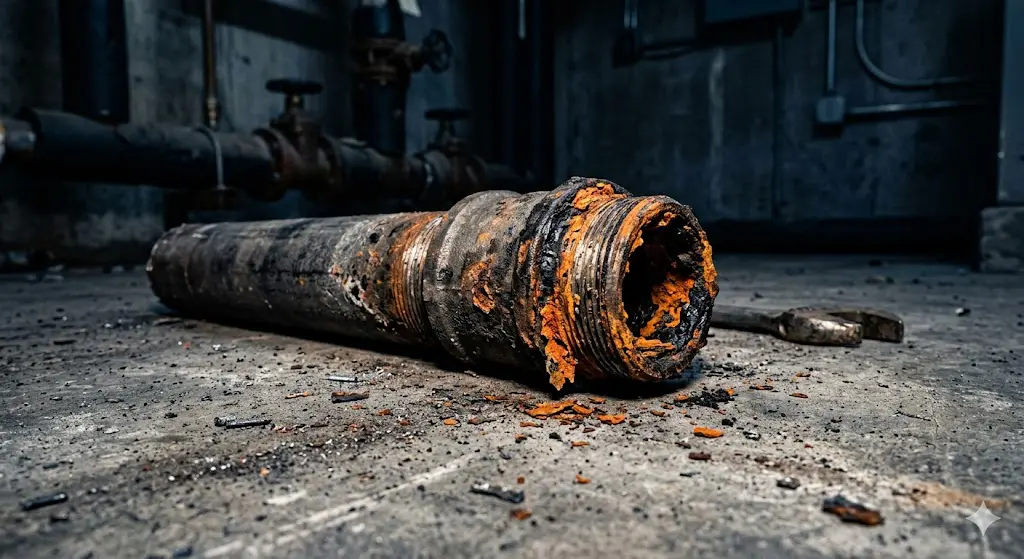
Magnetite is black iron oxide (Fe₃O₄) that forms when steel piping corrodes in low-flow or stagnant water conditions. In closed loop systems, magnetite circulates as abrasive particles that accumulate in coils, pump volutes, and heat exchanger plates — accelerating mechanical wear and reducing heat transfer efficiency over time.
Closed loop inhibitor programs — whether molybdate-based, nitrite-based, or azole-blended — work by maintaining a concentration band that keeps corrosion rates at an acceptable level. That concentration doesn’t hold itself.
Inhibitors are consumed over time as they react with corrosion sites, oxygen, and microbial activity. After a winter with minimal monitoring or no chemical additions, it’s common to find inhibitor levels 30 to 60 percent below the target range.
A loop running with depleted inhibitor has essentially no corrosion protection, and every hour it runs that way adds to the damage that will eventually show up as a coil leak or a pump replacement.
Chilled water loops run cool and dark — ideal conditions for biofilm to establish and spread. ChemREADY’s biocide programs are selected for closed system compatibility, not just general use, and applied on a schedule that actually prevents colonization.
| Parameter | Target Range | Out-of-Range Signal |
|---|---|---|
| pH | 8.0 to 9.5 (system-dependent) | Below 7.5: active corrosion risk. Above 10: copper and aluminum attack. |
| Inhibitor Level | Per program spec (varies by product) | Below minimum: no meaningful corrosion protection. Treat immediately. |
| Iron (dissolved + total) | < 1.0 ppm (ideally < 0.5 ppm) | Above 2 ppm: active corrosion underway. Particulate loading likely. |
| Conductivity / TDS | Baseline ± 20% (system-dependent) | Spike: contamination or makeup water issue. Drop: dilution or leak. |
| Biologics (HPC) | < 10,000 CFU/mL | Above 100,000 CFU/mL: shock biocide treatment required before cooling season. |
No single number tells the whole story. Iron in range with depleted inhibitor means your system has been corroding slowly. Iron elevated and inhibitor depleted means the system has been corroding fast, for a while. Pair those findings with low pH and elevated biologics and you have a system that needs intervention before it carries full cooling load — not after something fails.
The Guide Covers All Five Parameters On One Page, with plain-English explanations built for facility managers who receive water test reports and need to know what they’re actually reading.
A practical buyer's guide for evaluating boiler water treatment programs — covering chemistry, service levels, and total cost of ownership before you sign anything.
Fill out the form for instant access.
ChemREADY offers closed loop water analysis that gives you a clear picture of inhibitor levels, pH, corrosion byproducts, and biological activity — with a treatment recommendation attached. No guesswork, no sales pitch.
| Water Test Result | Recommended Action |
|---|---|
| Iron < 1 ppm, pH in range, inhibitor at or near target | Rebalance chemistry, verify filtration, and monitor closely through the first weeks of cooling season. |
| Iron 1–3 ppm, inhibitor depleted, pH drifted | Chemical recharge plus aggressive side-stream filtration. Resample in 30 days. |
| Iron > 3 ppm, dark water, multiple parameters out of range, biologics elevated | Full flush and recharge before the chiller carries load. This system has been corroding all winter. |
The right sequence: test first, then decide. Running a flush on a loop that doesn’t need one wastes time and chemicals. Skipping a flush on a loop that does need one sends accumulated corrosion products straight through your heat exchangers under full cooling load.
The water sample is a $30 decision that protects a $30,000 chiller.
The Chilled Loop Water Analysis Guide breaks down every parameter, target range, and warning threshold — one printable page for your mechanical room.
The hottest weeks of the year are when your chilled loop works hardest. That’s also when a coil leak causes the most disruption, when a pump failure is the hardest to schedule around, and when emergency service is the most expensive to dispatch.
Every problem that surfaces in July and August has roots that are visible and fixable in April and May. A water test and chemistry assessment before your chiller comes to full load is the lowest-cost intervention in your entire maintenance calendar. It costs a fraction of one strainer cleaning, and a rounding error compared to one emergency coil replacement.
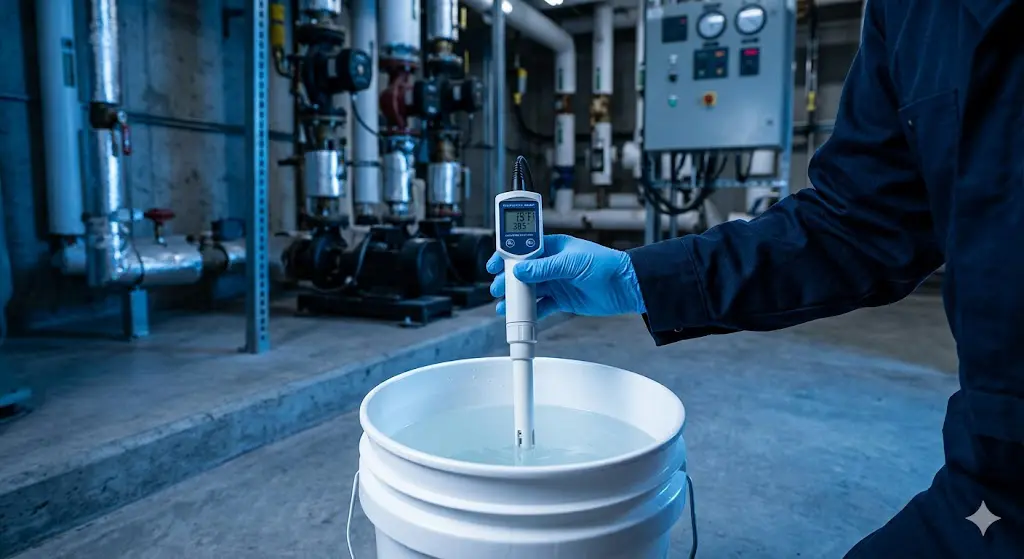
If your team isn’t pulling a sample from a low-point drain on your chilled loop this spring — or if you have a sample sitting on someone’s desk with numbers you’re not sure how to interpret — that’s the right place to start.
The guide includes the five parameters, what each one means for your specific system, and when numbers are bad enough to warrant a full flush versus a chemical recharge.