“Legionella consulting turns risk into control—mapping your water systems, setting clear limits for temperature and disinfectant, and verifying fixes so problems don’t return.”
“Legionella testing turns guesswork into control—targeted, site-specific sampling using standard methods (culture, Legiolert, PCR) with fast, plain-English reports so you can act before risk escalates.”
“Point-of-use filters give you an immediate, validated barrier at taps and showers—reducing exposure to Legionella while long-term system fixes are underway.”
“Legionella Water Management Plans turn scattered tasks into a single playbook—hazard analysis, clear control limits (temperature, disinfectant residual, flushing), routine monitoring, and defined corrective actions—so risk is managed daily, not after an event.“
Legionella pneumophila thrives in warm water systems between 77°F and 113°F — exactly the temperature range found in cooling towers, domestic hot water systems, and decorative water features throughout McKinney. With Texas’s warm climate, the risk window for Legionella amplification extends well beyond summer months, creating year-round exposure for facilities with vulnerable water systems. Any building with a cooling tower, centralized hot water distribution, whirlpool spas, or aerosol-generating water features carries Legionella risk that must be actively managed.
McKinney’s commercial and institutional landscape includes technology manufacturing, semiconductor and electronics, distribution and logistics, food processing, healthcare, and defense-adjacent manufacturing. Healthcare facilities, hotels, senior living communities, large office campuses, university buildings, and manufacturing plants with cooling towers are all high-priority candidates for ASHRAE 188 Water Management Plans. CMS specifically requires healthcare facilities to maintain water management programs, and the Joint Commission surveys for compliance during accreditation reviews. Beyond regulatory requirements, the liability exposure from a single Legionella case — settlements routinely exceed $1 million — makes proactive prevention a straightforward risk management decision.
The local water supply from surface (lavon lake via ntmwd) has characteristics that influence Legionella risk in McKinney buildings. Higher hardness water contributes to mineral scale formation inside distribution piping, which creates protected microenvironments where Legionella bacteria can colonize and multiply within biofilm. This makes regular environmental monitoring and proactive biocide treatment especially important for McKinney facilities operating on this water supply. TCEQ Region 4 (Dallas/Fort Worth) oversees environmental compliance in the McKinney area. While Texas does not currently mandate universal Legionella testing, the standard of care established by ASHRAE 188 means facilities that fail to implement water management programs face significant legal exposure if a case occurs.
EnviroTech’s McKinney service team delivers the full range of water safety services to commercial and industrial facilities across Collin County and the surrounding area. Every program is designed by Certified Water Technologists and supported by local service technicians who understand McKinney’s specific water chemistry and regulatory landscape.
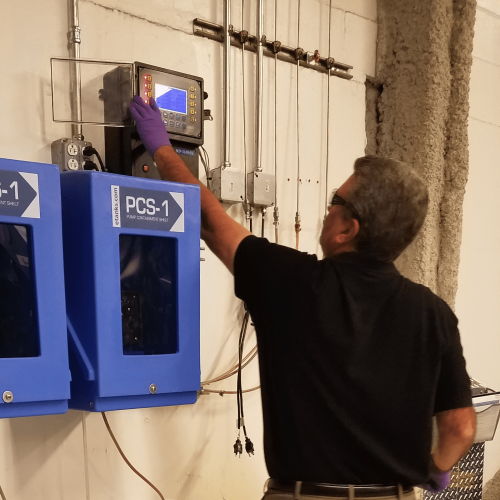
Our Legionella prevention methodology follows ASHRAE 188 and CDC guidance:
Q: What is Legionella and why is it a risk for McKinney buildings?
Legionella pneumophila is a waterborne bacterium causing Legionnaires’ disease, a severe pneumonia with a 5–10% fatality rate. In McKinney’s warm climate, Legionella thrives year-round in cooling towers, hot water systems, and any water feature creating aerosols. Building owners have a legal duty of care to manage this risk through proactive water safety programs.
Q: Is ASHRAE 188 compliance mandatory for McKinney facilities?
Texas does not mandate ASHRAE 188 by state law, but it represents the recognized standard of care. Healthcare facilities are effectively required to comply through CMS and Joint Commission requirements. Any McKinney facility experiencing a Legionella case will be measured against ASHRAE 188 in any investigation, litigation, or insurance claim.
Q: How often should McKinney facilities be tested for Legionella?
EnviroTech recommends quarterly Legionella culture testing for cooling towers minimum, with monthly testing during the May–October warm season. Healthcare and high-risk buildings should test monthly year-round. qPCR rapid testing provides results in 24–48 hours when faster turnaround is needed.
Q: What McKinney facilities need a Water Management Plan?
ASHRAE 188 defines building types requiring WMPs: healthcare facilities, hotels, senior living, and buildings with complex water systems. Given McKinney’s commercial base in technology manufacturing, semiconductor and electronics, distribution and logistics, food processing, healthcare, and defense-adjacent manufacturing, many facilities meet these criteria. Any building with a cooling tower or centralized hot water should evaluate its requirements. Free compliance assessments from EnviroTech.
Q: What does Legionella testing cost in McKinney?
Legionella culture testing costs $150–$300 per sample. Annual monitoring programs for typical commercial buildings run $3,000–$8,000 depending on scope. This cost is minimal compared to liability exposure — Legionella settlements routinely exceed $1 million, and wrongful death claims can reach $10 million or more.
EnviroTech provides water safety services throughout Collin County and surrounding areas. Our Fort Worth service team also serves:
Whether you need a new program, a second opinion, or emergency support, our McKinney-area team is ready.
7620 Flagstone St, Fort Worth, TX 76118, USA
(574) 254-0275
F: 330-425-8202
sales@getchemready.com
