Reading Time | 12 Minutes
Here’s what nobody in this industry likes to say out loud: having a Water Management Plan and being NJ S2188 Legionella compliant are not the same thing.
A lot of facilities across New Jersey right now are sitting on plans that look official, reference ASHRAE Standard 188, and technically check the box. But when you dig in — when you look at what’s actually being monitored, documented, and acted on — the gaps start showing up fast.
We see it constantly. Not because facility managers don’t care, but because many providers have no incentive to tell you what your plan is missing. A plan that looks complete keeps the contract. A plan that is complete takes more work.
Here are five things your current provider probably isn’t telling you — and what to do about each one before the September 2026 deadline makes the decision for you.
Most facilities assume their Water Management Plan covers them under NJ S2188 — until an inspector asks for five years of monitoring records. Use ChemREADY’s free one-page guide to see exactly where the gaps are. No cost. No obligation.
This is the single biggest misconception in Legionella compliance right now. NJ S2188 doesn’t just require a Water Management Plan. It requires a Water Management Program. Those are two very different things.
Quick Definition: A Water Management Plan is a document. A Water Management Program is that plan being actively executed — with monitoring logs, corrective action records, assigned responsibilities, and a verification process proving the controls are actually working.
| Water Management Plan | Water Management Program (Required by S2188) |
|---|---|
| A document describing water systems, risks, and control measures | The plan being actively executed every day, every week |
| States "we flush low-use outlets weekly" | Proves you did it — timestamps, every outlet, every week, reviewed |
| Exists in a binder or PDF | Lives in active monitoring logs and corrective action records |
| Written once, filed away | Reviewed, updated, and auditable at any time |
| May satisfy a checkbox audit | Required to satisfy NJ S2188 — 5 years of records, producible on demand |

A practical buyer's guide for evaluating boiler water treatment programs — covering chemistry, service levels, and total cost of ownership before you sign anything.
Fill out the form for instant access.
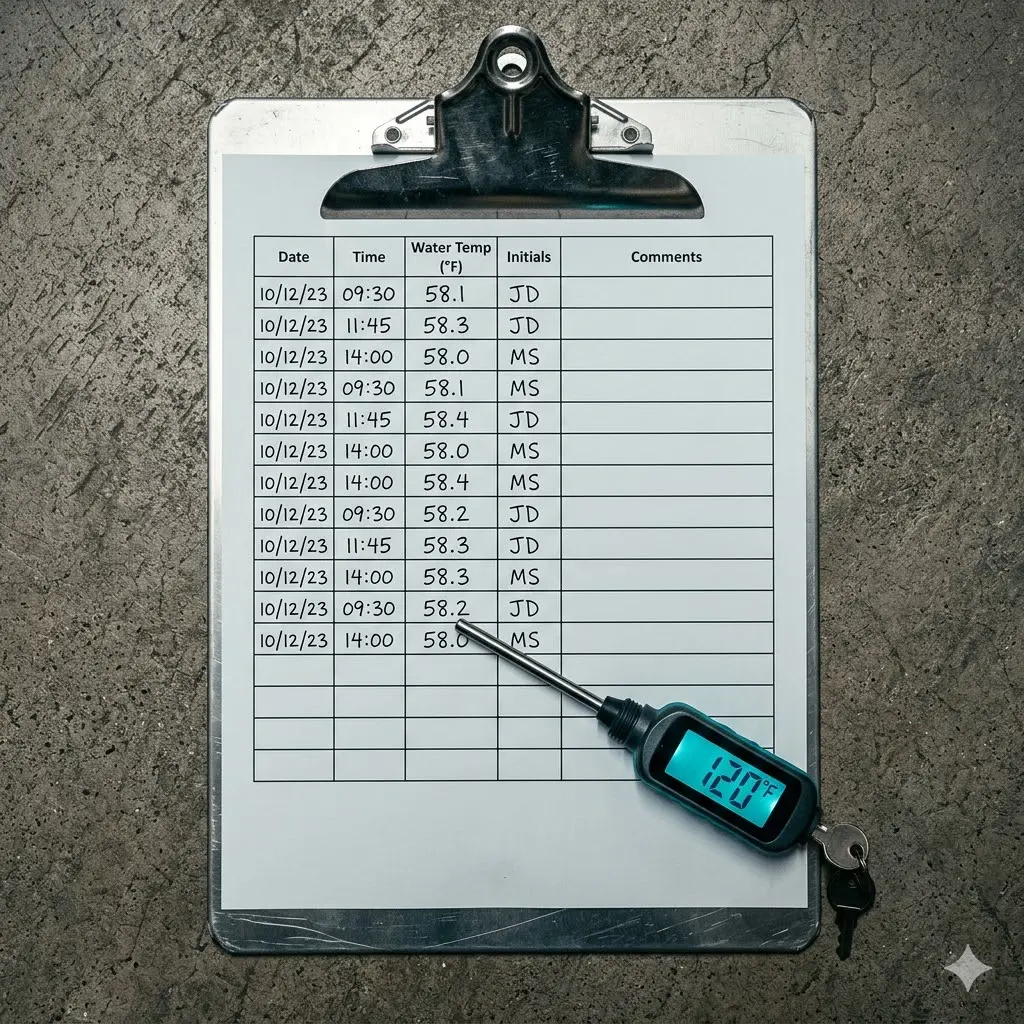
Under S2188, you need to maintain records of all water management procedures for at least five years and make them available to authorities upon request. If your documentation lives in scattered spreadsheets, email chains, or one person’s memory, you’re exposed.
One gap is manageable — two or three means your plan won’t hold up when it matters most. Download the free guide and see where your program stands before September 2026 does it for you. No cost. No obligation.
Plenty of providers will hand you a plan and tell you it’s “ASHRAE 188 compliant.” And technically, it might reference the standard. But compliance with ASHRAE 188 isn’t about citing the document. It’s about following its risk management framework, customized to your building.
ASHRAE 188 requires a site-specific risk assessment. That means someone has to physically evaluate your water systems: your hot water recirculation loops, your dead legs, your seasonal usage patterns, your cooling towers, your unique plumbing layout. A generic template with your building’s name swapped in at the top doesn’t qualify.
Here are the red flags that your plan might be template-based rather than truly site-specific:
Your flow diagram doesn’t match your actual building. If the plan includes a generic schematic that doesn’t show your specific water heater locations, recirculation paths, or dead legs from past renovations, it wasn’t built from a real assessment.
Control measures are copy-pasted across every zone. Different parts of your water system face different risks. A plan that applies the same control limits to your domestic hot water and your cooling tower makeup water isn’t analyzing your actual conditions.
There’s no mention of building-specific risk factors. Has your facility undergone renovations that created dead legs? Do you have seasonal wings that sit stagnant? Is your incoming municipal water supply subject to seasonal quality swings? If your plan doesn’t address these, it’s generic.
A truly compliant plan under S2188 follows the ASHRAE 188-2018 framework applied to your building’s actual layout, systems, occupants, and usage patterns. Anything less is a liability in disguise.
A clean Legionella result without a documented program behind it creates liability, not protection. Get the free guide and see what a compliant program actually requires. No cost. No obligation.
Some vendors position Legionella testing as the whole solution. “We’ll test your water quarterly, and if it comes back clean, you’re good.”
That’s not how any of this works.
Testing is one component of a Water Management Program. It serves as validation — confirmation that your control measures are working. But validation without the underlying program is like grading a test you never studied for. A clean result today doesn’t tell you anything about tomorrow if you don’t understand why it was clean.
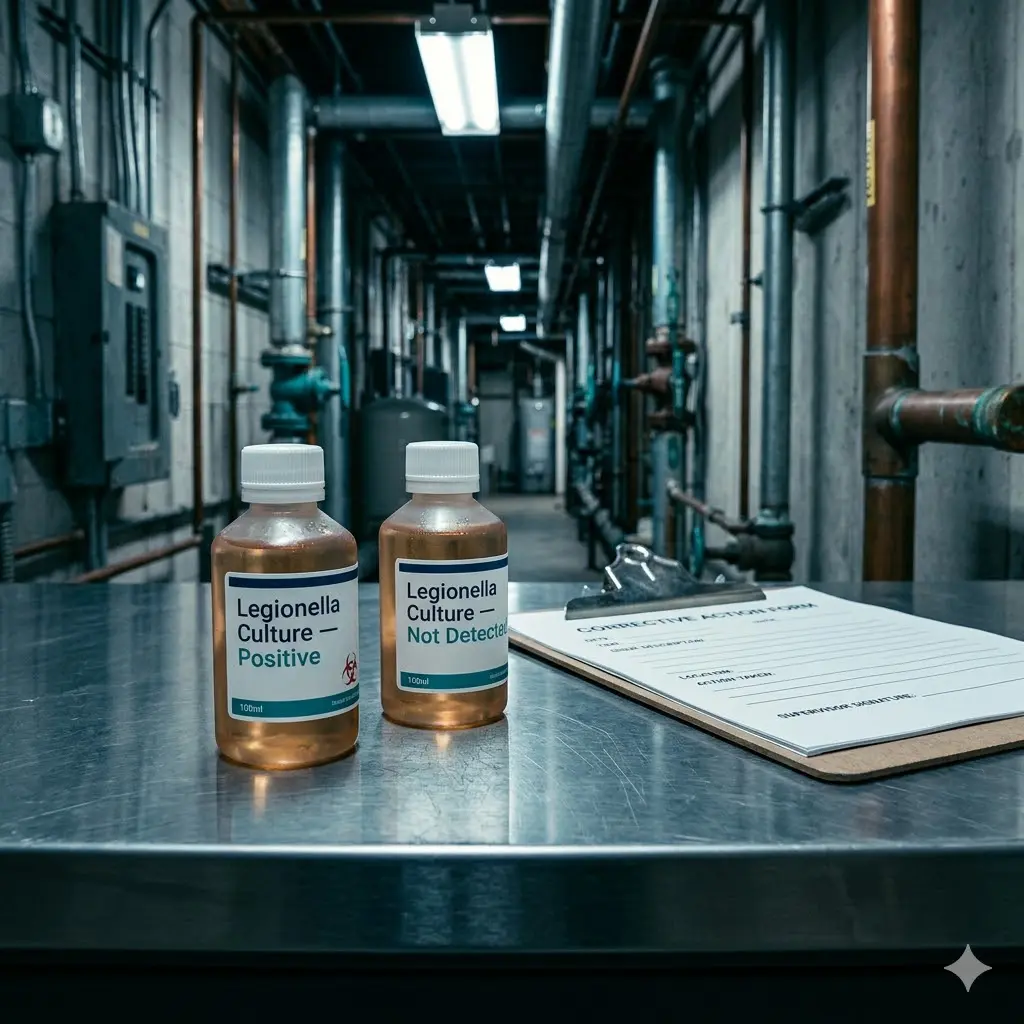
And here’s what many providers won’t tell you: a positive Legionella result without a documented program behind it is far worse than not testing at all. Why? Because once you have a documented positive result and no evidence of an active management program, you’ve created a paper trail showing you knew about the risk and didn’t have controls in place. That’s the exact scenario that triggers liability exposure.
An effective Water Management Program — with Legionella testing embedded within it — includes four non-negotiable components:
If your Legionella testing isn’t embedded within a documented program that includes all four, you have data without a safety net.
WARNING: Never cool a boiler rapidly by opening doors or running the combustion air blower. Thermal shock from accelerated cooling causes cracking and weakens tube-to-header integrity. Always isolate the boiler and allow natural cooling to ambient temperature.
A plan written in 2024 and never touched again is already falling out of compliance by 2026. See what a living Water Management Program looks like — free one-page guide. No cost. No obligation.
Your building changes. Your water systems change. Your occupancy patterns change. Renovations create dead legs. Seasonal shutdowns create stagnation. New equipment alters flow rates. Staff turnover means the person who understood the program last year isn’t here anymore.
S2188 requires facilities to regularly review and update their water management plans based on ongoing research, changes in standards, and the latest industry practices. A plan written in 2024 and never touched again is a plan that’s already falling out of compliance by 2026. At minimum, your plan should be reviewed annually — and immediately after any significant renovation, occupancy change, or equipment modification.
This is where most providers quietly step back. Writing the initial plan is a billable project. Keeping it current requires ongoing attention: reviewing logs, updating risk assessments after renovations, revising control limits when system conditions change, and retraining staff when roles turn over.
At ChemREADY, we partner with HC Info to support Legionella Water Management Plans (LAMPS) — a cloud-based system designed to keep documentation organized, updates simple, and audits less painful. Because a plan that can’t be maintained in real life isn’t a plan. It’s a false sense of security.
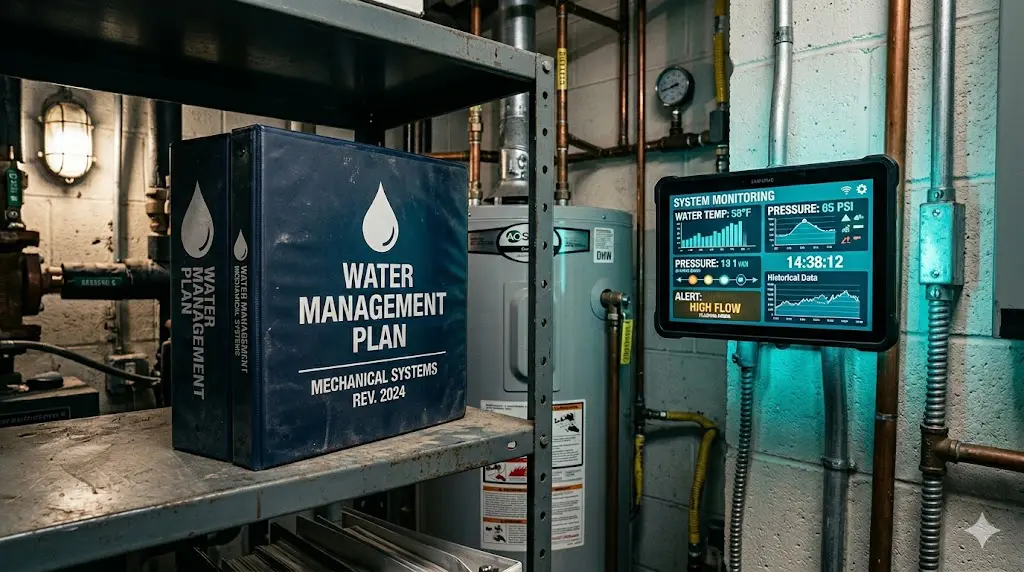
Pairing a living WMP with digital remote monitoring creates real-time visibility into the conditions that matter most: temperature, disinfectant residuals, flow patterns. You’re no longer relying on monthly spot-checks to catch problems that develop in days.
This one might sting, but it needs to be said: Legionella risk management is a specialized discipline. It’s not the same as general water treatment, and not every company that treats your cooling tower or boiler is equipped to build and maintain a compliant Water Management Program under S2188.
S2188 aligns compliance with ASHRAE 188, a standard that requires specific expertise in risk assessment, hazard analysis, control measure design, and documentation protocols. It’s closer to infection control methodology than traditional water chemistry. Here’s what to look for in a qualified provider:
ASSE 12080 certification. Look for ASSE 12080 certification in Legionella Water Safety and Management. This isn’t a “nice to have.” It’s the industry credential that demonstrates specific training in WMP development, risk assessment, and remediation protocols. If your provider can’t cite this certification, keep looking.
They don’t just write plans. They run programs. Any consultant can produce a document. The question is whether they’ll be there to help you execute it: conducting the ongoing monitoring, reviewing logs, adjusting controls when conditions change, and supporting your team through corrective actions when limits slip.
They integrate treatment with management. Legionella control isn’t just documentation. It’s chemical treatment (biocides, corrosion inhibitors, scale control), system design, monitoring technology, and program management working together. If your compliance provider doesn’t also understand your water chemistry, you’re managing risk with one hand tied behind your back.
They have skin in the game. A provider who only writes the plan and walks away has no accountability for whether it works. You want a partner who’s involved in the day-to-day execution, because their reputation is on the line alongside yours.
September 2026 gets all the attention. But the real risk isn’t the deadline. It’s the gap between what you think your program covers and what it actually does.
Fines under S2188 start at $2,000 for a first violation and can reach $10,000 per day in cases involving serious injury or death. But penalties are just the financial dimension. The reputational damage from an outbreak tied to a documented plan that wasn’t being executed? That’s the exposure most facilities aren’t thinking about.
The facilities that come out of this in the strongest position won’t be the ones who scrambled to get a plan in place by the deadline. They’ll be the ones who asked the hard questions now, addressed the gaps honestly, and built programs that actually work — not just on paper, but in practice.
That’s the difference between compliance and confidence.
Most NJ facilities have a plan. Far fewer have a program that would survive a real audit or a real outbreak. Download the free guide and find out which one you have. No cost. No obligation.