Reading Time | 9 Minutes
If your facility reduces or shuts down chilled water circulation during winter, the water inside those loops has been stagnant for weeks or months. That dormancy creates conditions most teams don’t think about until something breaks: corroded piping, iron-laden water, depleted inhibitors, and bacterial growth that silently degrades your system before cooling season even starts.
A spring flush is a targeted intervention that removes accumulated winter damage and resets your water chemistry before the system carries full cooling load. If you’re managing a closed loop system (getchemready.com/water-treatment/water-treatment-services/closed-loop-services/) at a commercial or industrial facility, this guide covers what happens during dormancy, how to tell if your system needs attention, and what a proper flushing procedure involves step by step.
THE DORMANCY CASCADE
Inhibitor depletes → Corrosion accelerates → Iron accumulates → Bacteria feed on iron and inhibitor → Biofilm forms → pH drops → Corrosion accelerates further. A spring flush interrupts this cycle before it reaches mechanical failure.
Corrosion and Iron Accumulation
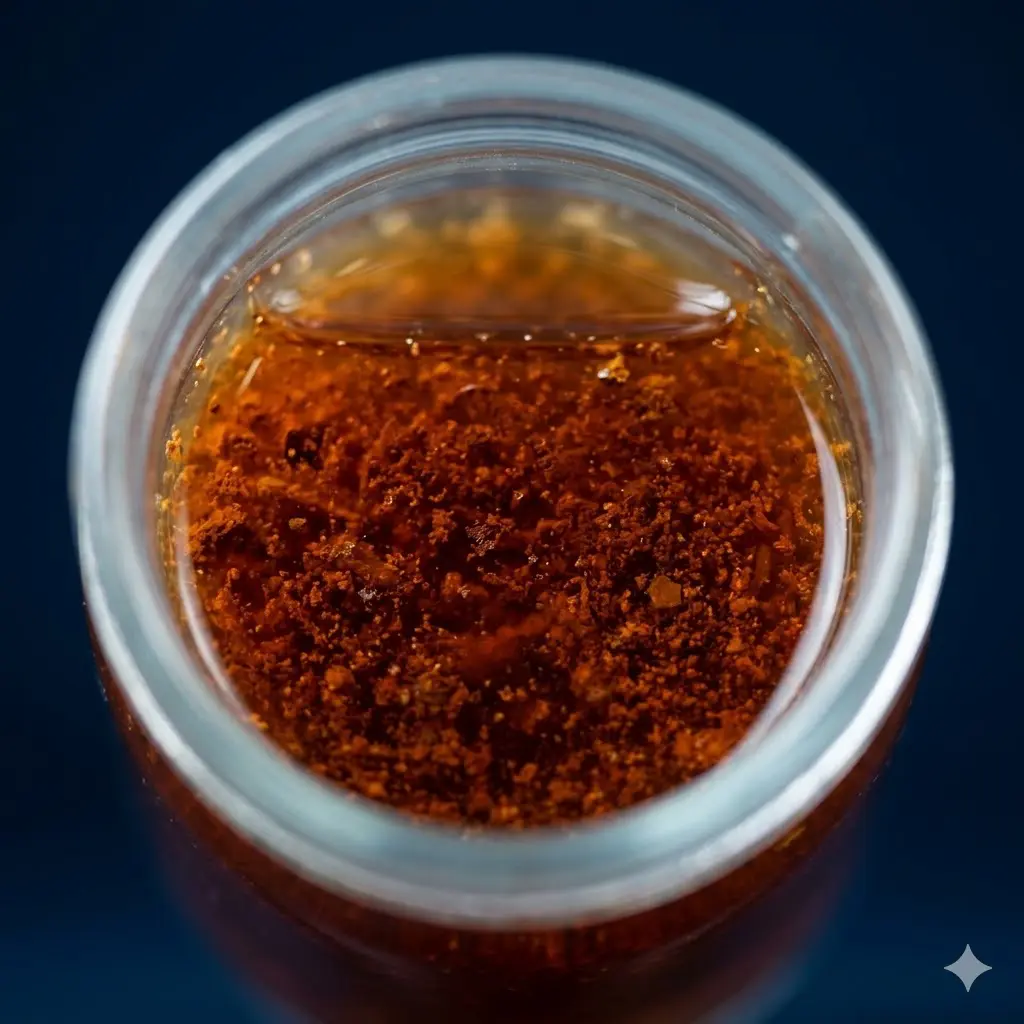
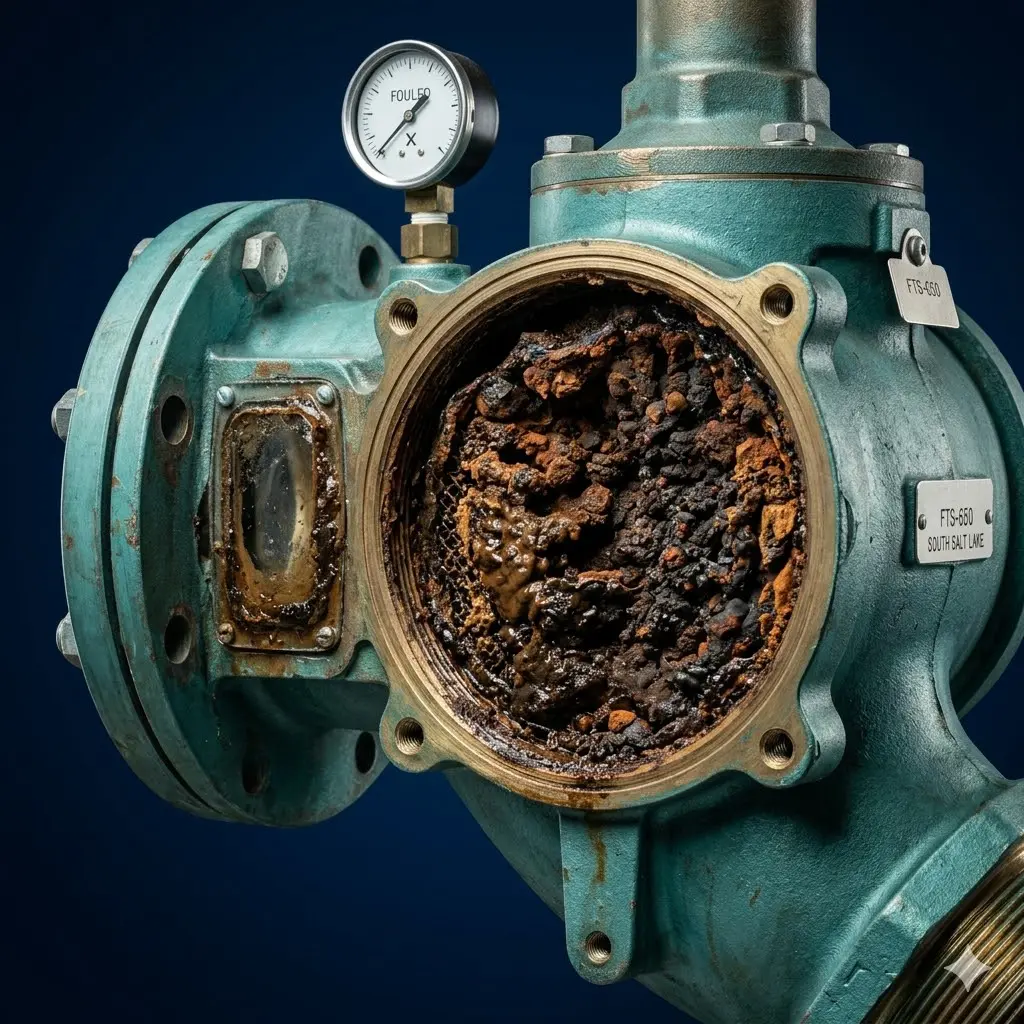
Oxygen pitting is the most common corrosion mechanism in closed loops. Deposits on metal surfaces create oxygen-differential cells—the area beneath the deposit becomes an anode, the surrounding metal becomes the cathode, and localized corrosion generates iron oxide particles. Without circulation, inhibitor can’t reach affected areas, so corrosion proceeds unchecked. The byproducts—primarily black magnetite (Fe₃O₄)—settle in low-velocity areas during dormancy and resuspend all at once when the system restarts: plugging strainers, fouling coils, restricting flow, and potentially damaging pump seals. (Learn more about how closed loop water treatment prevents these problems: getchemready.com/water-facts/effective-closed-loop-water-system-treatment/)
Bacterial Colonization and Biofilm
Certain bacteria use corrosion inhibitors like sodium nitrite as an energy source, consuming the chemistry meant to protect the system. These bacteria form biofilms that insulate heat transfer surfaces, create localized corrosion cells, and block treatment chemicals from reaching metal. Expansion tanks and dead legs become concentrated contamination reservoirs. (For more on nitrite-based closed loop treatment and how to maintain it: getchemready.com/water-facts/nitrite-closed-loop-water-treatment-an-introduction-to-efficient-water-treatment/)
Chemical Degradation and pH Drift
Glycol breaks down over time, producing organic acids that lower pH. Low pH accelerates corrosion, which generates more iron, which feeds more bacteria. Even non-glycol systems lose inhibitor concentration through minor leaks and maintenance top-offs. After a full winter, your loop chemistry may be significantly outside its target parameters. If your system uses glycol, ChemREADY offers custom-blended glycol solutions (getchemready.com/water-treatment/water-treatment-services/closed-loop-services/) that combine freeze protection with long-term corrosion control.
A printable 1-page checklist your maintenance team can use to evaluate your closed loop before cooling season. Covers visual inspection, water sampling, mechanical checks, and go/no-go criteria for flushing.
In most facilities, heating is winding down but cooling hasn’t hit full demand yet. That gives you a window to take the loop offline without impacting operations. Wait until summer, and you’re flushing a system that’s already supposed to be carrying peak load—leading to rushed work and scheduling headaches.
The economics are straightforward. A planned spring flush costs a fraction of a single emergency repair. A plugged strainer is a minor inconvenience. A fouled heat exchanger drives up energy bills for months. A corroded coil that bursts under summer load is a five-figure emergency plus water damage, lost cooling, and accelerated equipment replacement. Every year of deferred maintenance increases the severity and cost of the eventual problem.
ChemREADY’s Total-Service-Management™ programs (getchemready.com/water-treatment/water-treatment-services/) are designed to catch these problems before they compound—combining scheduled service visits, water testing, chemical management, and reporting into a single preventive maintenance plan.
A flush is more than draining and refilling. At ChemREADY, we use a structured Five-Step Closed Loop Reset Protocol that addresses every dimension of dormancy damage: particulate, biological, chemical, and mechanical.
Step 1: Assess
Pull a water sample to measure iron, pH, conductivity, inhibitor residual, bacteria count, and glycol concentration. Visually inspect the water—dark or rust-colored samples indicate significant iron contamination. Check pump seals, expansion tanks, and pressure gauges. Fix any leaks before flushing.
Step 2: Clean
Circulate a non-acid, biodegradable cleaning solution through the entire system, including every secondary loop, dead leg, and expansion tank. Skipping isolated sections is the most common reason facilities flush in spring and still have problems by July. Circulation time: 24–48 hours for light fouling, up to 96 hours for heavy contamination.
Step 3: Flush
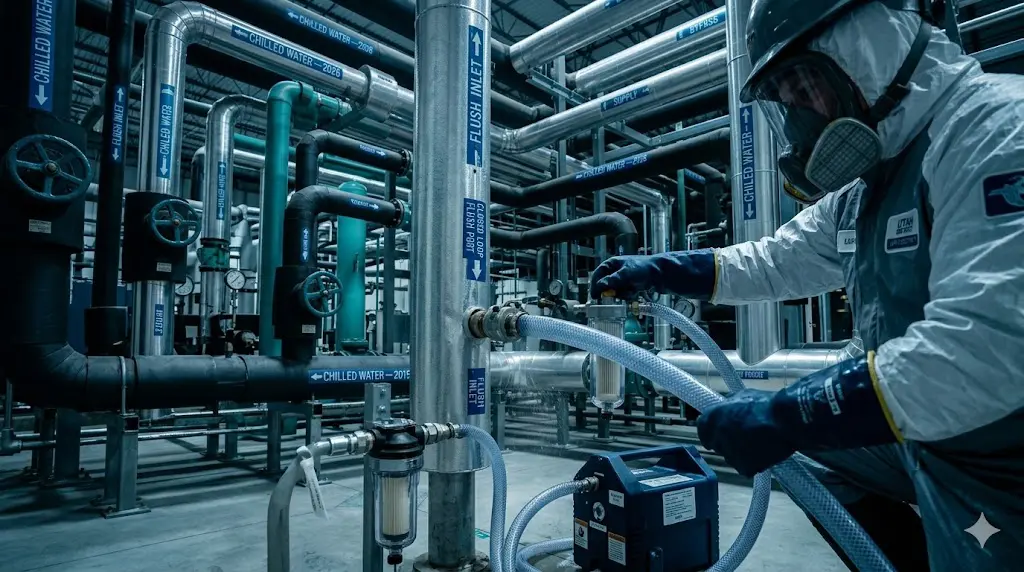
Open a drain at the lowest point and flush at one to two gallons per minute. Monitor loop pressure closely—flushing too fast can cavitate pumps. Continue until the conductivity of draining water matches makeup water. This step can take days to weeks. It cannot be rushed.
Step 4: Decontaminate
Apply biocide through the full system to kill remaining bacteria. The biocide must reach every zone opened during cleaning—a partial treatment leaves surviving bacteria that repopulate quickly.
Step 5: Protect and Document
Reintroduce corrosion inhibitor chemistry (getchemready.com/water-treatment/water-treatment-chemicals/closed-loop-treatment/) matched to your system’s metallurgy. Take a confirmation water sample to establish the post-flush baseline—your reference point for every monitoring visit throughout cooling season.
The complete technical guide to ChemREADY’s flushing methodology. Includes step-by-step procedures, completion criteria for each phase, recommended chemical products, water sampling parameters, and a post-flush documentation template.
Not every system needs a full flush every spring. But if you’re seeing any of the following, schedule a water sample and consultation:
One indicator warrants investigation. Three or more means a full flush should be your next call. Not sure where you stand? Request a free system assessment (getchemready.com/contact-us/) and we’ll pull a water sample and give you a straight answer.
Test regularly. A tight system should be tested every one to three months. Track trends, not just individual readings—if iron has risen across three consecutive tests, you have a corrosion problem that needs intervention before the next quarterly visit.
Control makeup water. Every gallon of untreated makeup dilutes your inhibitor and introduces oxygen. Makeup shouldn’t exceed 5% of system volume annually. If it does, finding and fixing the leak takes priority over adding more chemical.
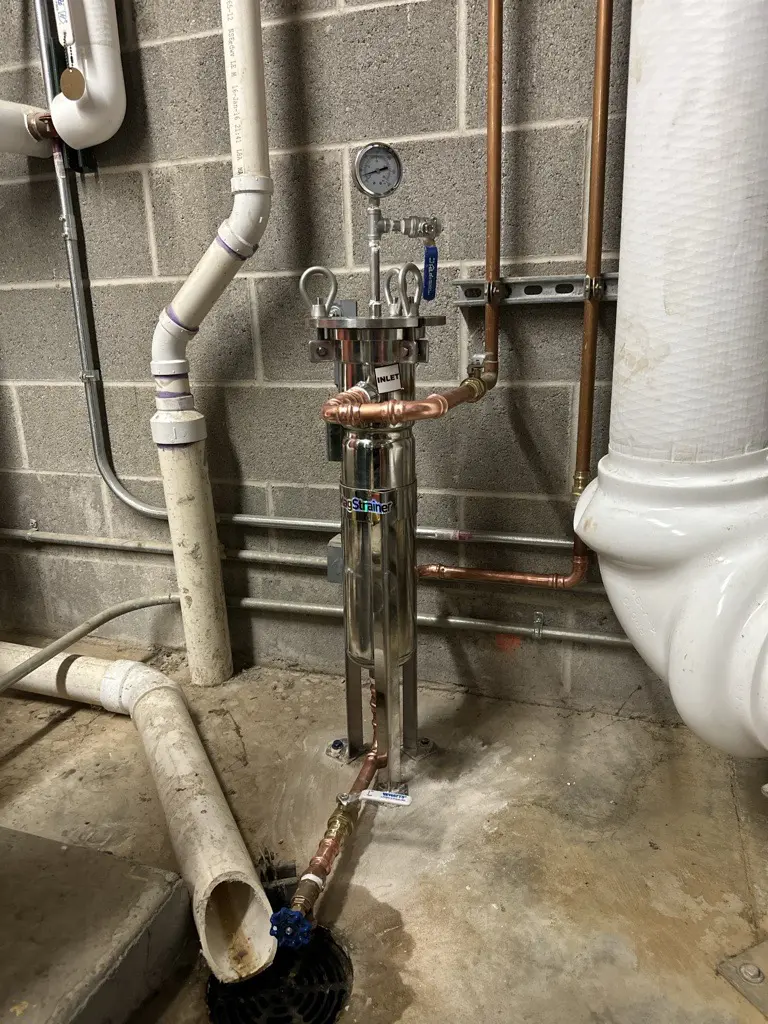
Add filtration. ChemREADY’s MagStrainer™ magnetic filtration (getchemready.com/water-treatment/water-treatment-services/closed-loop-services/) and Neptune Filter Feeders capture ferrous and non-ferrous particles before they can settle or erode equipment—extending the interval between full flushes and reducing unplanned service calls.
Consider automated monitoring. Real-time controllers track corrosion rates, inhibitor levels, and water quality trends continuously, catching drift before it becomes damage. ChemREADY offers automated monitoring and smart controllers (getchemready.com/water-treatment/water-treatment-services/) as part of our comprehensive closed loop programs.
Most chilled water loops restart in spring carrying months of corrosion, iron buildup, and depleted chemistry. This free checklist helps your maintenance team catch it before cooling season hits full load.
Data-first assessment. We tailor cleaning chemistry, flush duration, and post-flush treatment to your specific system—not a cookie-cutter protocol.
Whole-system cleaning. We clean dead legs, expansion tanks, secondary loops, and drip legs—the isolated zones most providers skip.
Proprietary chemistry. Our closed loop treatment formulations (getchemready.com/water-treatment/water-treatment-chemicals/closed-loop-treatment/) target dissolved solids, regulate pH, remove oxygen, and passivate metal surfaces. NSF-compliant and backed by decades of field experience.
Integrated filtration. After flushing, we install MagStrainer™ and Neptune Filter Feeders for continuous particulate control.
Plain-English reporting. Every visit produces a clear report: what we found, what we did, what the numbers mean, and what to watch for.
A dormant closed loop isn’t just sitting still — it’s corroding, depleting, and growing bacteria. Take two minutes to check where yours stands before you need it most.
How often should a closed loop be flushed?
Most systems benefit from a flush every one to three years, depending on water chemistry, system tightness, and operating conditions. Systems with seasonal shutdowns should be evaluated annually in spring.
How long does a full flush take?
The complete Five-Step Reset Protocol takes one to three weeks. Chemical cleaning requires 24–96 hours of circulation. Physical flushing can take several days to several weeks depending on system volume.
What’s the difference between a flush and a full cleaning?
A flush removes suspended contaminants with fresh water. A full cleaning adds a chemical step that dissolves adhered deposits and biofilm before flushing. For a system dormant all winter, the full cleaning-then-flush approach is recommended.
Schedule a free on-site closed loop assessment. We’ll pull a water sample, evaluate your system, and give you a clear recommendation—no obligation.